Markets and strategies
Defense: a hot topic at the start of 2026
The start of 2026 was marked by a flurry of defence-related news. We have summarised the main points here.
Published le 2 February 2026
Military actions and operations
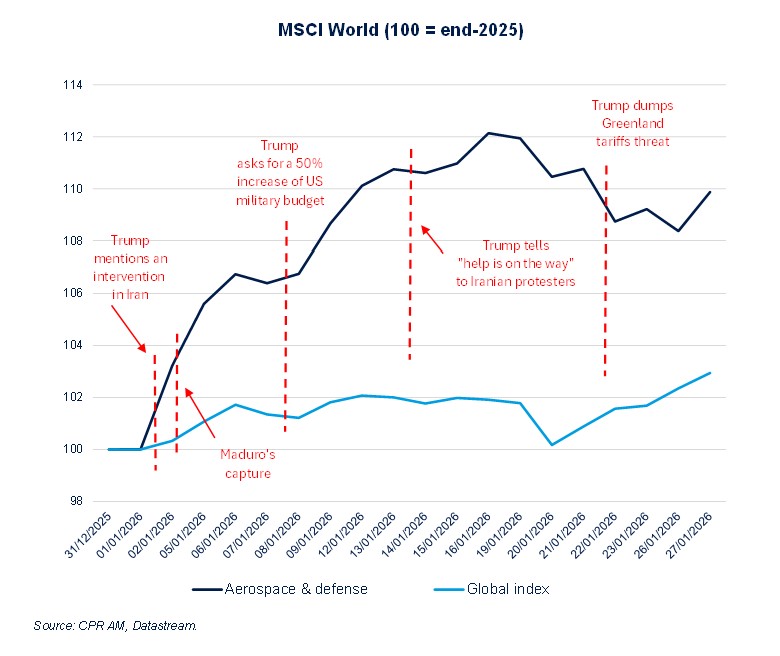
- On 2 January, Donald Trump indicated that the "United States is ready to intervene" if the Iranian regime kills demonstrators.
- On 3 January, U.S. special forces captured Venezuelan President Nicolas Maduro and took him to the United States.
- On 13 January, Donald Trump told the Iranian protesters that "help is coming". There has been no U.S. military intervention in Iran so far, but the U.S. has moved many military assets into the region over the month, raising the possibility of intervention.
- On 23 January, The 1st trilateral negotiations for a ceasefire have started in Abu Dhabi between Russians, Ukrainians and Americans. Volodymyr Zelensky assures that an agreement in principle has been reached with the United States on the security guarantees it could provide. The question of the future of the territories located in the east of Ukraine remains the main sticking point between Russians and Ukrainians.
- On 26 January, Xi Jinping was strengthening his grip on the Chinese military by announcing an investigation into the top officer of the "Central Military Commission".
- In the wake of the capture of Nicolas Maduro and in the context of the revival of the Monroe Doctrine (which evokes a hegemony of the United States over the American continent as a whole), the question of a hypothetical annexation of Greenland by the United States has been raised. On January 21, Donald Trump announced that he had an agreement with NATO on the island. Several Nordic pension funds have announced that they are reducing their exposure to US assets.
Investment in defense
- On 7 January, Donald Trump has asked Congress for a 50% increase in the US defense budget (in 2024, military spending represented 3.4% of GDP).
- On 15 January, The United States and Taiwan have announced a trade agreement, under which the island commits to a $40 billion increase in its military budget.
- On 19 January, The European Commission has approved a 1st wave of €38 billion in loans for 8 countries, Belgium, Bulgaria, Denmark, Spain, Croatia, Cyprus, Portugal and Romania, as part of the European SAFE (Security for Action for Europe) programme, which will enable joint purchases of military equipment.
- On 23 January, Czechoslovak Group (CSG), a producer of ammunition and armoured vehicles, has been listed on the Amsterdam Stock Exchange, the largest IPO ever for a defence player.
- On 26 January, It validated a second group of national defence plans under SAFE, leading to the approval of €74 billion in loans for Estonia, Greece, Italy, Latvia, Lithuania, Poland, Slovakia and Finland. The 1st payments will take place in March.
- On 27 January, Japanese Prime Minister Sanae Takaichi was speaking in a televised address about Japan's stance in the event of a conflict between the United States and China over Taiwan. A few weeks ago, his government decided to accelerate the increase in military spending towards the 2% of GDP target (which was 1.4% of GDP in 2024). Throughout January, tensions between Japan and China over Taiwan persisted, including the introduction of restrictions on rare earth exports.
The intense focus on defence has meant that the sector has significantly outperformed the major stock market indices since the start of the year, whether in the American, Asian or European markets. This has most likely contributed to the sharp rise in the price of gold and other precious metals at the start of the year. In any case, tensions between major powers mean that military budgets are likely to continue to increase over the next few years.
Find out more