European strategic autonomy — what progress since 2022?
European strategic autonomy is a theme that has strengthened in recent years as Europe faces structural changes in its environment.
Published on 4 February 2026

Nearly four years after its launch, the war in Ukraine continues and the Russian threat to European territories appears long‑lasting. US defense support has already decreased notably, including for Ukraine, and EU–US trade relations remain difficult with recurring threats of higher tariffs and regular attacks on EU digital regulation. At the same time, Europe is confronted with a new wave of Chinese competition after that of the early 2000s, which now affects future technologies, electric vehicles, machine tools …
All of this means that issues of security, industrial support and energy security resonate strongly with Europeans’ concerns.
A year ago, the Draghi report highlighted the objective of strengthening the European Union’s economic security and proposed three workstreams: reduce dependencies, reduce the innovation gap with the United States and succeed in reconciling the decarbonisation of the European economy with competitiveness. Here we take stock of recent progress.
Where do we stand on energy dependence?
The energy sector is central for Europe both for the decarbonisation of the economy and the net zero trajectory but also for the competitiveness of European industry. The RePowerEU1 programme, launched in 2022 with €300 billion of financing, has helped to considerably reduce dependence on Russian energy and to develop renewable energies.
One dependence replaces another
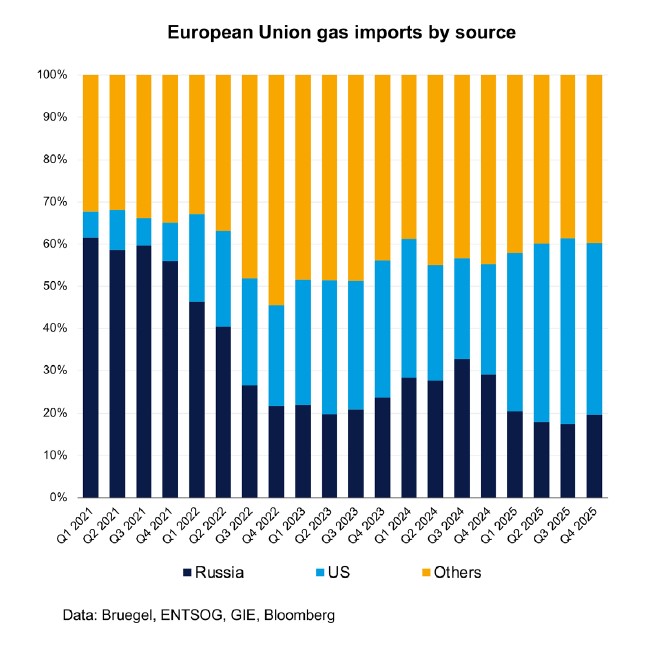
Since the start of the war in Ukraine, dependence on Russian gas has fallen sharply. It represented less than 20% of the European Union’s gas imports in 2025 compared with nearly 60% in 2021. Conversely, the share of American liquefied natural gas imports has increased sharply, from less than 10% in 2021 to nearly 40% today. A positive point: supplies excluding Russia and the United States have also increased, rising from 30% to 40% of imports between 2021 and 2025.
The development of low carbon energies has reached a new milestone
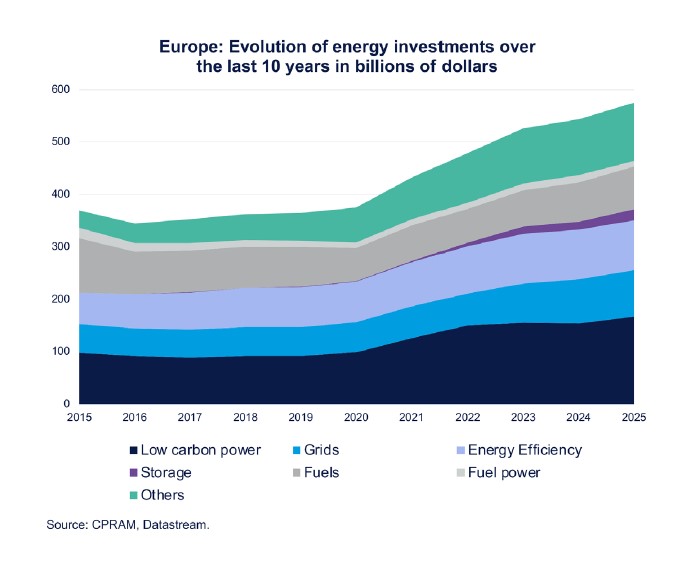
Investments in the development of renewable energies doubled in 10 years, reaching $390 billion in 2025. And this has had results since electricity production from renewable sources exceeded that produced from fossil fuels for the first time in 2025. However, pressure remains strong on the deployment of low carbon energies because electricity consumption by data centres is expected to double between 2023 and 2030 according to the International Energy Agency’s forecasts.
Today, investment in electricity grid infrastructure is of particular importance, because the modernization of grids must keep pace with the expansion of low emission electricity production.
Annual spending on grids and storage exceeded $100 billion in 2025, more than double the amount invested ten years earlier. Despite recent progress, needs remain acute in terms of security, flexibility and matching between places of production and consumption. To accelerate matters, the European Commission launched in December 2025 a package dedicated to energy grids (Grid package) which has a €30 billion budget and intends to facilitate administrative authorizations, better coordinate trans European projects by prioritising eight “energy highways”.
Defense spending increases are already a reality
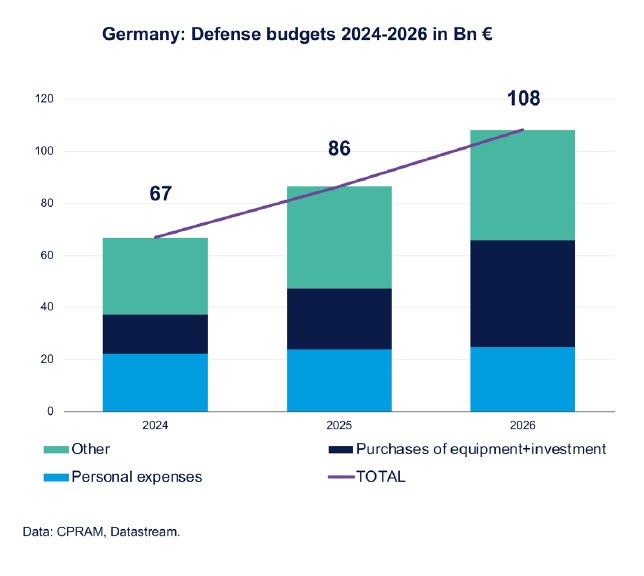
The Commission’s ReArm Europe / Readiness 20302 plan, announced in February 2025 with €800 billion of financing, is beginning to be implemented across European countries.
National budgets for 2026 foresee significant increases in military spending thanks to the possibility of activating the national derogation clause of the Stability and Growth Pact for defense spending and to the SAFE programme3 (Security for Action for Europe). For example, military spending increases by €22 billion (+21%) in Germany and by €6.7 billion (+13%) in France in 2026 compared with 2025.
The SAFE programme provided for €150 billion of loans for joint purchases of military equipment. Its implementation is rapid since the first disbursements will take place as early as March 2026. Indeed, the European Commission has just approved a first wave of €38 billion of loans for 8 countries, then a second of €74 billion for 8 others.
Finally, the EU budget foresees the use of programmes linked to cohesion policy to increase defense spending.
New sectoral plans and ongoing regulatory simplification
The European Commission has placed competitiveness among the seven priorities of its mandate. Its competitiveness compass, which constitutes its roadmap in this area, is organised around two axes — regulatory simplification and strengthening the Single Market. It targets €37.5 billion of administrative cost savings for businesses over the period 2024–2029. In this context, it adopted 10 Omnibus simplification packages in 2025, rolling back in the process some flagship measures of the Green Deal. It also plans for 2026 the creation of a new legal regime, the “28th regime”, so that innovative companies can operate across the Single Market without having to comply with 27 national regimes.
Energy is one of the main competitiveness issues for industry. The Clean Industrial Act4 launched in February 2025, targets affordable energy through the deployment of low carbon energies, electrification and strengthening physical interconnections between countries, in line with RePowerEU. Moreover, the Commission pursued its sectoral support plans in 2025 with the adoption of plans for automotive, for space, for AI with InvestAI5 (€200 billion) and for the chemical industry. Early 2026 focuses on digital with a new Chips Act expected in Q1 2026 as well as measures on Cloud and AI development. Another highly anticipated text is the European Product Act for H2 2026 which will redefine rules on products, their conformity and the standards applied.
In recent years, Europe has managed to strengthen its sovereignty in the fields of defense and energy, driven by necessity and proactive policies. By contrast, it remains very dependent on the United States and China technologically. Developing ecosystems favourable to innovation, mobilising significant public private financing, and fighting market fragmentation continue to shape the roadmap of industrial policies for the coming years.
1 https://commission.europa.eu/topics/energy/repowereu_fr
2 https://commission.europa.eu/topics/defence/future-european-defence_en
3 https://defence-industry-space.ec.europa.eu/eu-defence-industry/safe-security-action-europe_en
4 https://commission.europa.eu/topics/competitiveness/clean-industrial-deal_en
5 https://digital-strategy.ec.europa.eu/en/news/eu-launches-investai-initiative-mobilise-eu200-billion-investment-artificial-intelligence
Find out more