What impact is hyperscaler bond issuance having on bond markets?
The sharp rise in hyperscaler bond issuance has been one of the defining developments in financial markets in 2026. In this note, we review these trends and assess their impact on both the US and European bond markets.
Published on 23 September 2026

Unprecedented capex needs are driving a shift toward external funding
AI infrastructure requires massive investment, given the growing need for computing power, data storage and the associated electricity consumption. Hyperscalers are at the core of this cycle. The term refers to cloud service providers that operate vast data-centre networks and deliver infrastructure, platform and software services at very large scale. In this note, we use the term hyperscalers to refer to five US companies: Alphabet, Amazon, Meta Platforms, Microsoft and Oracle.
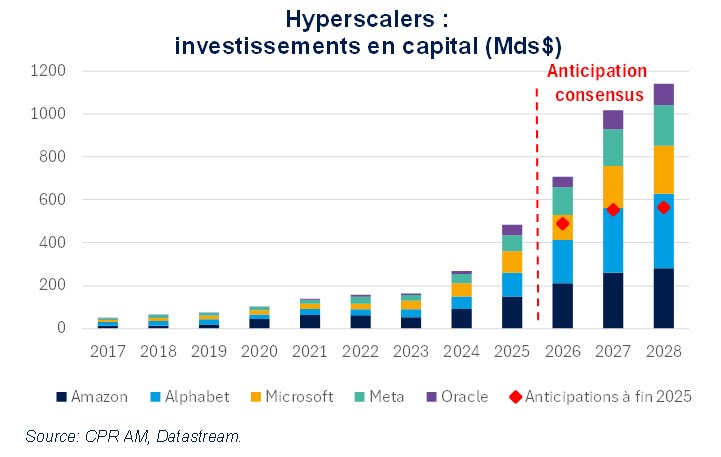
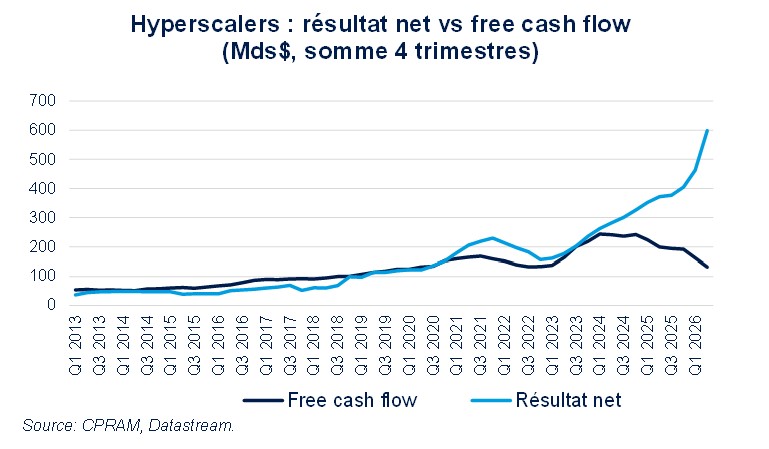
Taken together, these five companies are expected to invest around $1tn in 2027, equivalent to roughly 3% of current annual US GDP. These amounts have become too large to be funded solely through internal cash generation. As a result, hyperscalers have gradually shifted away from a self-funded model toward greater reliance on capital markets, including debt markets through bond issuance.
A spectacular surge in bond issuance
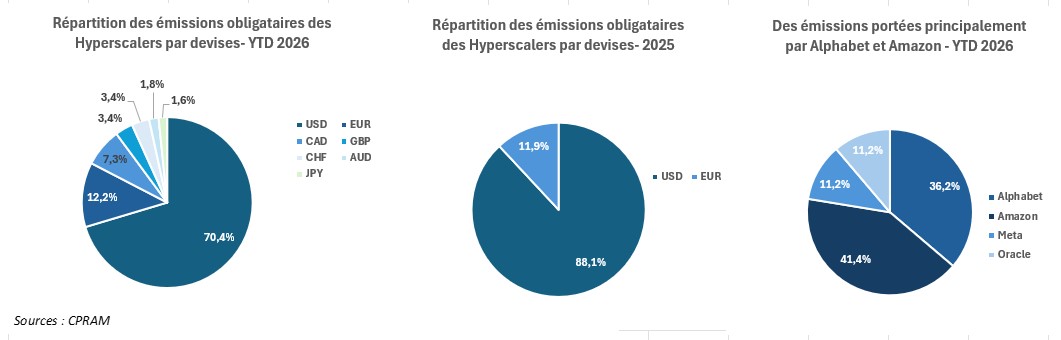
This change in funding strategy has translated into a sharp acceleration in hyperscaler bond issuance. Since the start of 2026, they have issued around $223bn in bonds, or $117bn more than in full-year 2025.
What is new in 2026 is the expansion of issuance beyond the US dollar, with euro-denominated bonds now accounting for a much more meaningful share. This marks a genuine diversification of funding sources for these groups. Of the $223bn issued since the beginning of the year, $27.3bn was denominated in euros, or 12.2% of the total.
In practice, the five hyperscalers are becoming increasingly significant players in corporate bond markets, both in dollars and in euros. We look at this in more detail below.
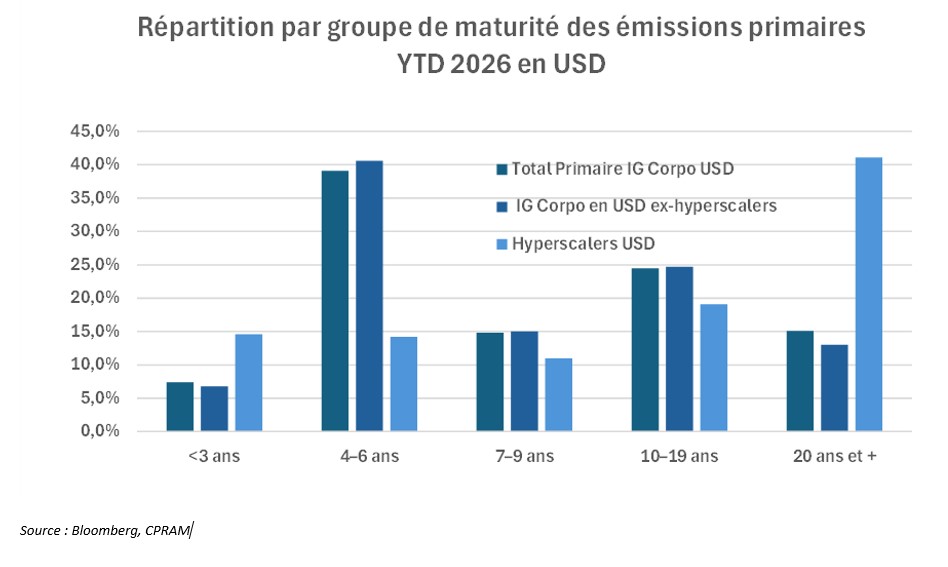
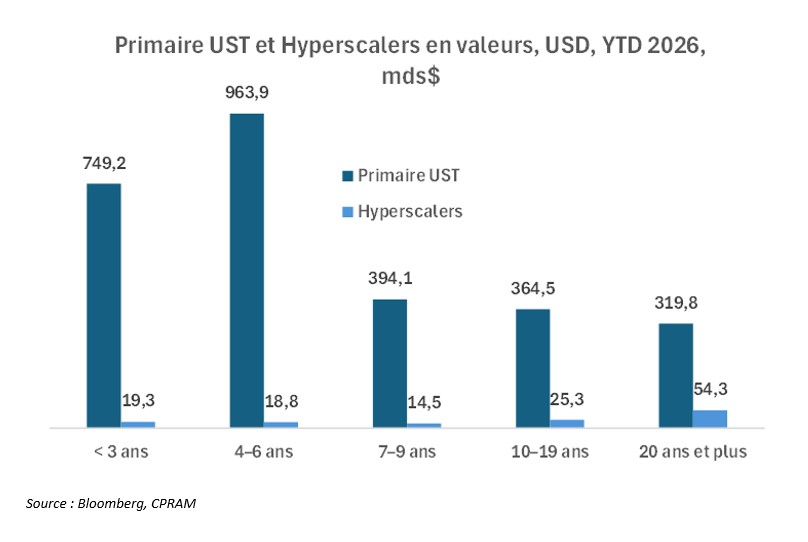
Let us start with the dollar market, which is the natural funding market for these US-based companies. Since the start of the year, hyperscalers have issued $132bn of dollar-denominated bonds, representing 7% of the US investment grade corporate primary market year to date.
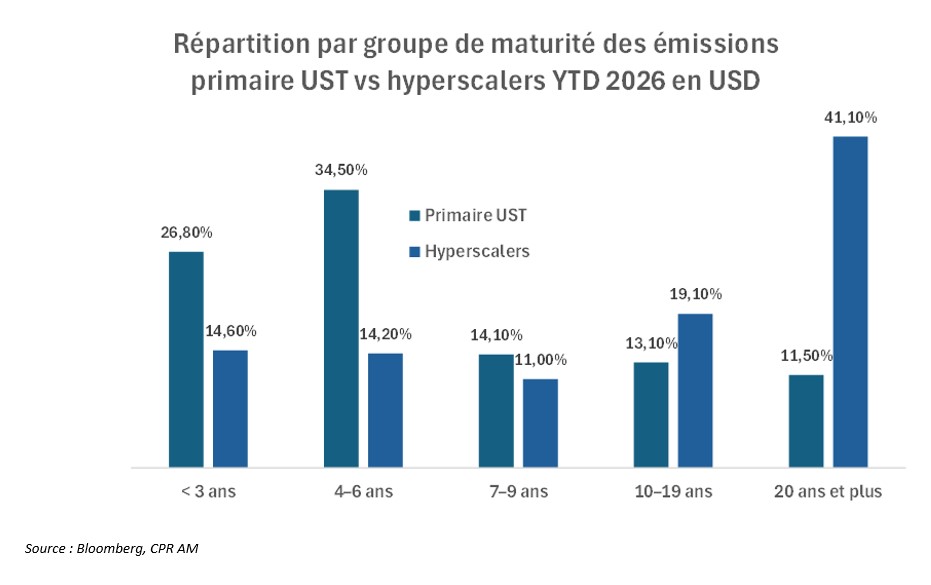
A distinguishing feature of this issuance is its strong bias towards long maturities. More than 40% of hyperscaler issuance in 2026 has come in maturities of 20 years or more, compared with 15% for the overall US investment grade corporate primary market and 13% for the same market excluding hyperscalers.
A similar maturity gap can be seen relative to US Treasury issuance. Since the start of the year, US Treasury gross issuance has totalled around $2.7tn across all maturities, with roughly 13% and 11.5% issued in the 10-19 year and 20+ year buckets respectively. By contrast, the corresponding shares for hyperscaler issuance are 19% and 41%. These are meaningful volumes: in the 20+ year segment alone, hyperscaler issuance amounts to roughly 17% of the volume issued by the US Treasury.
Their weight in bond indices is also rising rapidly and should continue to increase in the coming years. In the Bloomberg US Investment Grade Corporate Bond Index, hyperscalers already account for close to 5% of the overall index and 7.5% of the long end, defined as 10 years and over.
This highlights the growing presence of new issuers with credit ratings close to those of sovereigns. They are creating new investment opportunities and adding diversification at the long end of the curve, a segment that has historically been dominated in corporate credit by perpetual hybrids and long-dated senior unsecured bonds. Their growing presence at the long end is also expanding the opportunity set for investors such as insurers and pension funds.
Multi-currency diversification: the growing importance of the euro and the long end of the curve
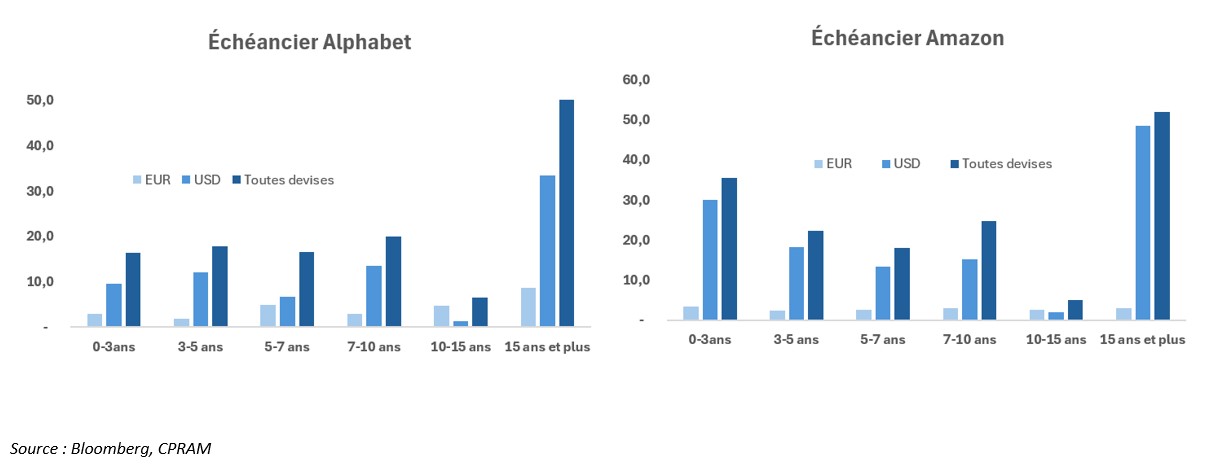
As noted above, hyperscalers’ funding strategy is no longer confined to dollar issuance. Their objective is to broaden their investor base, reduce funding costs and match financing with the currencies in which spending is incurred. Issuance of reverse Yankees, that is, bonds issued by US companies in foreign currencies, has risen sharply. The euro has emerged as the preferred offshore funding currency for hyperscalers in this first major wave of non-dollar issuance and now represents close to 10% of their outstanding bond debt. Since the start of 2026, hyperscalers have issued €23.5bn in Europe, alongside CHF 5.9bn and £9.75bn.
This year, Amazon and Alphabet have been the largest issuers in the euro non-financial corporate bond market, with Amazon’s March deal setting a record in absolute size for that market at €14.5bn across multiple tranches. In the euro market too, hyperscalers have shown a preference for long maturities, as illustrated by Alphabet’s and Amazon’s debt profiles. Of the €9bn and €14.5bn issued respectively by Alphabet and Amazon in 2026, €4.25bn and €4.75bn were issued in maturities beyond 10 years. Overall, in the 10+ year segment, hyperscalers account for 9% of the euro corporate primary market in 2026.
In euros, hyperscalers currently make up around 1% of the Bloomberg Euro Corporate Index, rising to 4% at the long end, defined as over 10 years, which points to a more material impact on that part of the curve.
The euro market is therefore more than a simple diversification outlet: it is becoming a preferred market for long-dated issuance. This trend has two consequences. First, it adds depth to the euro credit curve at longer maturities, an area that has historically been relatively sparse outside sovereign and supranational issuers. Second, it is establishing US technology as a lasting reference sector in European credit indices, even though its weight there still remains below that seen in comparable US indices.
Beyond the euro, the same logic applies to other currencies such as the Australian dollar: these companies have the capacity to access multiple markets as needed. This optionality gives them an unprecedented ability, for private issuers, to calibrate supply across markets.
Moderate but visible credit deterioration, and a rating/spread disconnect : Still-substantial financial flexibility in the eyes of rating agencies
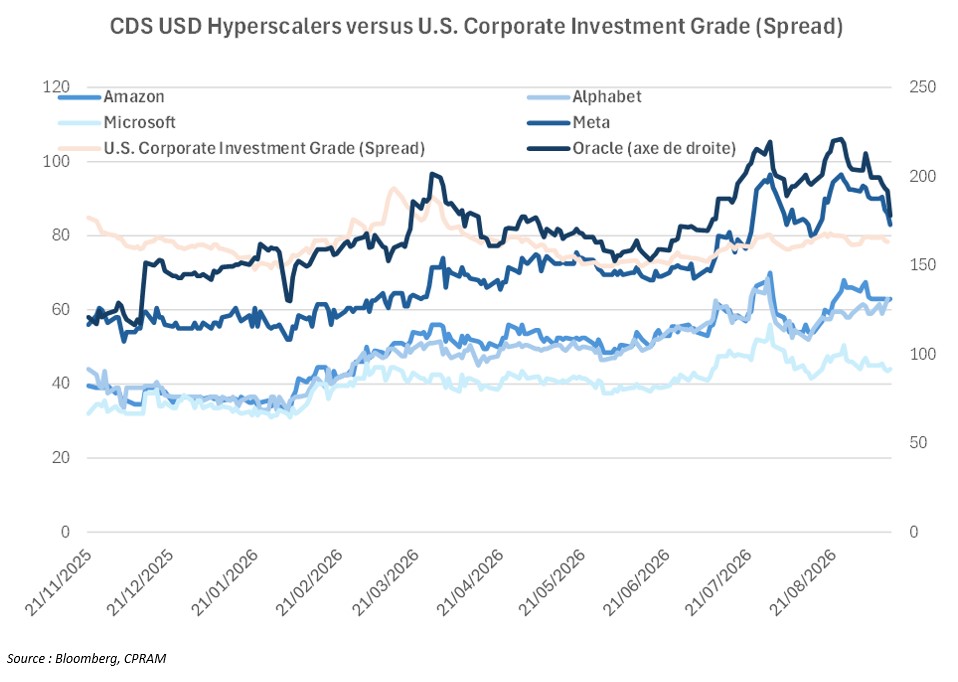
With hyperscalers’ investment plans and associated borrowing rising sharply, markets have in recent weeks begun to question whether these companies will generate a sufficient return on investment. As a result, their credit risk premia have widened in both cash bonds and CDS markets.
The mechanical consequence has been a disconnect between hyperscaler bond spreads and their formal credit ratings. As of 7 September 2026, euro investment grade issuers rated AAA and AA offered average OAS spreads of 31.9bps and 50.3bps respectively, compared with a composite euro spread of 85bps for hyperscalers. By way of reminder, Alphabet and Amazon are rated AA+ Stable and AA Stable respectively by S&P.
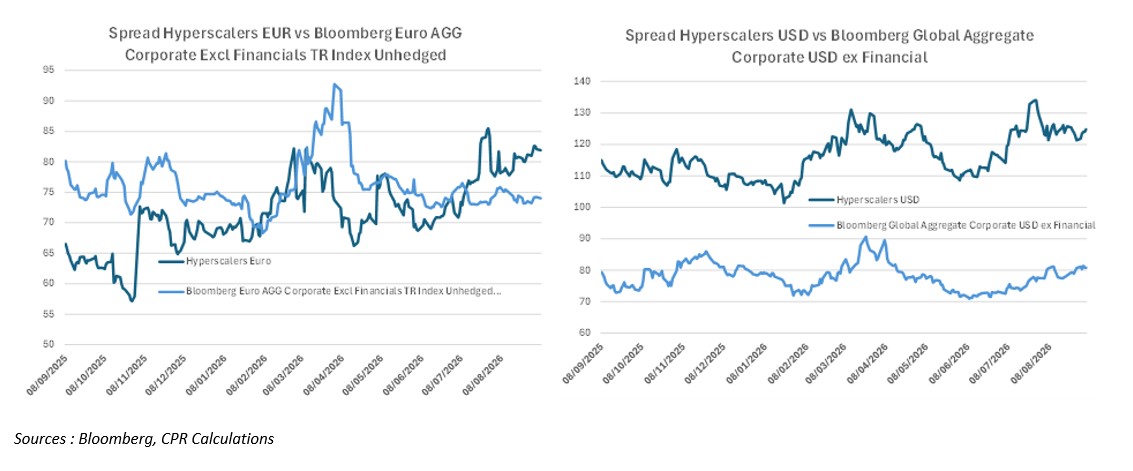
Despite this initial repricing, hyperscalers still retain considerable financial flexibility before any meaningful rating downgrade becomes likely. Their balance sheets remain very strong, which explains why ratings have stayed high despite the rapid increase in leverage.
This room for manoeuvre, across currencies, markets, maturities and issue sizes, allows them to absorb a shift in market perception without immediately facing the consequences of a downgrade, unlike more constrained issuers. This is precisely why spreads can adjust ahead of rating agency action. Lastly, hyperscalers’ investment spending must be considered alongside their return on invested capital, or ROIC, which still provides a relatively comfortable buffer at this stage.
Long-term investor positioning and the potential for a reverse crowding-out effect
For long-term investors, hyperscaler bonds may represent an alternative to certain traditional assets, as they combine high credit quality with long duration, a relatively rare profile in the euro market outside sovereign debt. While there is a risk that these issuers could be downgraded, it is worth noting that their bonds are already trading at spreads consistent with ratings several notches below their current ones.
A recent ECB note raises the question of whether the accumulation of hyperscaler issuance could create a crowding-out effect by pushing up funding costs for all issuers. Its conclusion is that hyperscaler issuance may have contributed to higher long-end yields in the US, while no such effect has yet emerged in Europe, although this remains a development to watch over the coming quarters.
For long-term investors, there are several reasons why hyperscaler debt should be seen as an additional investment segment at the long end of the curve, complementing rather than replacing traditional long-duration assets:
- The size of sovereign debt markets, in both euros and dollars, remains far too large for long-dated hyperscaler debt to compete with them in any material way.
- The investment rationale for sovereign bonds and corporate bonds is not the same: the former offers macro exposure, while the latter provides sector exposure.
- For insurers, alongside pension funds, the main investors at the long end of the curve, sovereign and corporate bonds are not treated in the same way under the Solvency II market risk module, particularly with respect to spread risk and concentration risk. In this framework, debt issued by EU member states is subject to a zero spread shock, regardless of rating or duration, and is not subject to issuer concentration limits. By contrast, corporate bonds are subject to a spread shock that depends on credit rating and modified duration. This spread shock measures the loss in value of a bond in the event of credit spread widening, and therefore requires insurers to hold more regulatory capital.
- Because hyperscaler bond spreads are not aligned with their formal credit ratings, investment decisions need to be assessed on a spread-implied rating basis, which effectively places them below higher-rated sovereign debt.
More broadly, some investors may use hyperscaler debt to support the overall rating profile of their portfolios while capturing relatively attractive spread at this stage, that is, before any potential rating downgrades occur.
The sharp rise in hyperscaler bond issuance is one of the key macro-financial developments of 2026. It is likely to reshape the corporate bond market in dollars, and probably in other currencies such as the euro, on a lasting basis. These bonds are expected to form a distinct investment universe with unique characteristics, providing diversification benefits and potentially reshaping, over time, the 15+ year segment of the US dollar corporate bond market.