10 years after the Paris Agreement, what are the challenges of COP 30?
COP 30 will be held in Belém from November 10 to 21, 2025, 10 years after the Paris Agreement and the collective commitment to limit global warming well below +2°C compared to pre-industrial levels.
Published on 10 October 2025
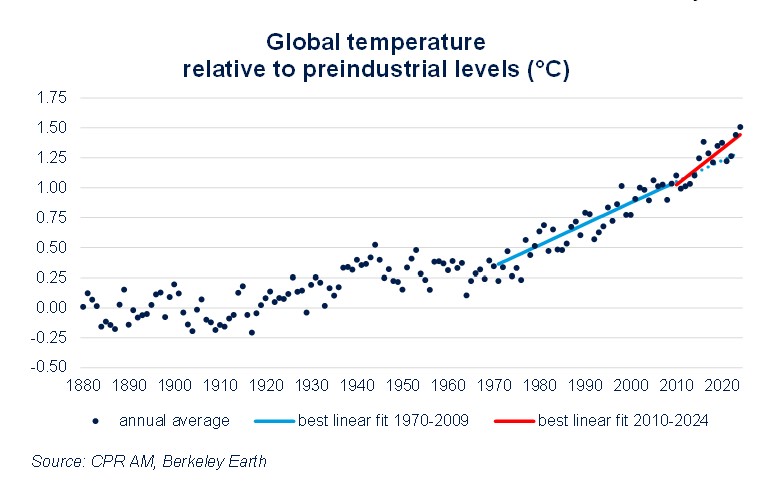
After a COP 29 deemed disappointing and a pressing demand for reform of the climate discussion process, which has become increasingly complex, COP 30 aims to be the one of action. The Executive Secretary of the UNFCCC (United Nations Framework Convention on Climate Change), Simon Stiell, hopes it will be an opportunity to go "further, faster, and more fairly." For its part, Brazil wants COP 30 to be the one of "implementation" after several COPs of commitments. The challenge is particularly significant as the global temperature exceeded, in 2024 and for the first time, 1.5°C above the pre-industrial era, and President Trump announced the United States' withdrawal from the Paris Agreement upon his arrival at the White House. This withdrawal will become effective in January 2026.
The main issues of this new COP following the interim negotiations that took place in June in Bonn
The reform of the decision-making process to gain efficiency
More than 200 NGOs and representatives of civil society have called for a reform of the decision-making process, which is considered too cumbersome and complex. Several proposals have been put forward: limiting national delegations to 200 members, moving to majority decision-making, setting stricter agendas...
The update of the Nationally Determined Contributions (NDC)
That is to say, the climate commitments of states. The year 2025 is the deadline for the submission of commitments for the 2035 horizon, called NDC 3.0. These contributions must be based on the results of the first global stocktake, the Global Stocktake, conducted in 2023, which estimated that global temperatures would increase by about 2.1 to 2.8°C if all NDCs were implemented. However, it noted that 87% of the global economy had a climate neutrality target. As of October 2, 2025, only 62 of the 194 expected NDCs had been submitted.
The overall issue of climate finance with several dimensions
At COP 29 in Baku, developed countries agreed to increase their climate financing to developing countries to reach $300 billion per year by 2035, which constitutes the current "new collective quantified goal" (NCQG). However, developing countries estimated their annual climate financing needs at $1.3 trillion. The gap is even more significant given that, in the meantime, the United States, which was the main contributor to climate financing, has canceled all its climate-related aid, and several European countries have announced that they will reduce their development aid financing. Moreover, many countries in the Global South link the ambition of their NDCs to financial support from the North.
Other negotiation points concern the sources of financing (public grants, public loans, private investment, targeted taxes...) and the allocation of funds between mitigation, adaptation, and loss and damage. Commitments for loss and damage suffered by developing countries remain very low today, that is, less than $800 million, of which less than half has actually been disbursed.
Azerbaijan and Brazil have been mandated to develop a "Baku-Belém Roadmap" to advance on financing-related issues and to finalize a roadmap by the end of October 2025 ahead of COP 30.
The objectives of a just transition
These objectives, which must be integrated into the NDCs, will also be at the heart of the discussions in Belém. Developing countries are particularly sensitive to the human impacts of the transition: decent work, respect for community rights, inequalities, access to energy... The Bonn conference in June 2025 has already published an informal note that will serve as the basis for the COP30 discussions.
The global goal on climate change adaptation (GGA: Global Goal on Adaptation)
In 2023, the parties agreed on a general framework for climate change adaptation, particularly in the priority areas identified as food, water, and health. They initiated work on defining "indicators" of adaptation since there is currently no concrete and measurable indicator to monitor countries' efforts to adapt to climate change. The Bonn conference resulted in a list of 490 potential indicators, but the goal is to finalize a list of about one hundred indicators, some global and others specific to certain regions.
The issue of funding adaptation
This point, which refers to the financial support from developed countries for adaptation measures in developing countries, will also be at the heart of the negotiations. At COP26 in 2021 in Glasgow, countries set a goal to double climate finance for adaptation between 2019 and 2025. A 2024 report from the United Nations Environment Programme found that public financial flows for climate change adaptation to developing countries had significantly increased between 2021 and 2022, rising from $22 billion to $28 billion. However, even if this trend continued, it would only cover about 5% of the financial needs for adaptation.
The commitments to phase out fossil fuels
After obtaining a declaration of intent at COP 28, "transition away from fossil fuels," the goal is to achieve clearer and more precise targets for phasing out coal and oil.
The protection of forests and the official launch of a special TFFF fund (Tropical Forest Financing Facility).
This investment fund, comprising public and private stakes, aims to invest in government bonds and distribute the income to countries with significant forest cover that make efforts to combat deforestation and commit to preserving their forests.
As we will see, the way the major powers (China, United States, European Union) view COP 30 is very different.
The European Union, divided, did not finalize its new NDC on time
In September, the European Environment Ministers adopted a declaration of intent to reduce greenhouse gas emissions by -66.25% to -72.5% by 2035 compared to 1990 levels. This is to be refined in the coming weeks or months. In spring 2025, the European Commission had proposed reducing greenhouse gas emissions by 90% by 2040, compared to 1990, in order to achieve carbon neutrality by 2050, but several countries have recently requested to renegotiate this target at the European summit to be held at the end of October. This has blocked the adoption of the 2035 target and led to a delay in the publication of the new European NDC.
China has committed to quantified targets for the first time
China has announced that it will reduce its emissions by 7 to 10% by 2035 compared to their peak.
This is the first time China has announced a quantified target for reducing its emissions. Although some observers have judged this announcement to be too timid, it is to be welcomed nonetheless, given the American disengagement on the climate issue.
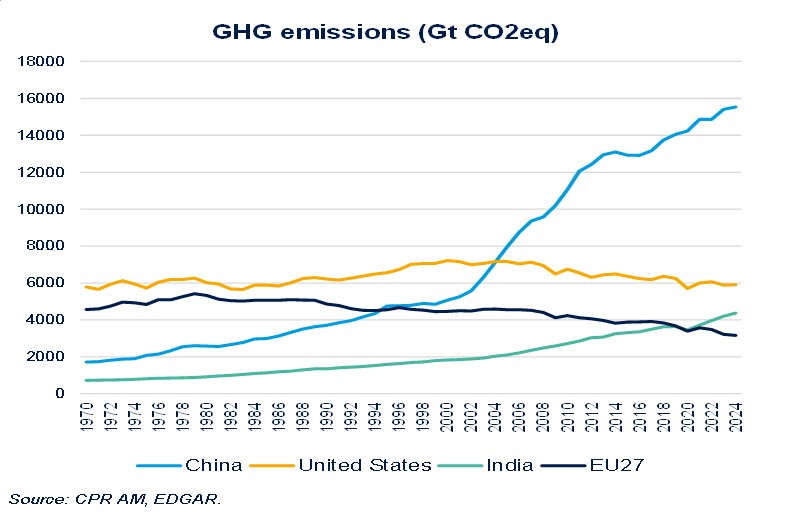
Some analyses indicate that China's emissions peak would have been reached in 2024, whereas its previous NDC simply aimed for a peak before 2030. If China's emissions trajectory is so significant, it is because it is by far the largest greenhouse gas emitter in the world (with emissions five times higher than the European Union and 2.6 times higher than the United States) and a simple 10% reduction would be equivalent to the aggregated emissions of the 120 countries in the world that emit the least. Moreover, the increasingly significant investments in clean energy and technologies in this country can have a ripple effect for the rest of the world, beneficial for the fight against climate change.
The United States potentially absent from the negotiations
The Biden administration had set an ambitious goal for the United States to reduce greenhouse gas emissions by 61 to 66% by 2035 compared to 2005 levels. The Trump administration's 180-degree reversal on energy policy, canceling support for the energy transition and favoring fossil fuel production, makes this goal completely unrealistic.
In April 2025, Marco Rubio eliminated the Global Change Office, which represented the United States in international climate change negotiations. The United States stayed away from the interim negotiations in Bonn and did not confirm whether it would send an official delegation to Belém or not.
Organizers fear that the absence of the United States will lead to less ambitious commitments from the international community, particularly from China. The United States has regularly urged China to make more ambitious climate commitments, and their cooperation on combating climate change has continued through several U.S. administrations. In 2021, the two countries reached a significant agreement, committing to develop renewable energy and limit greenhouse gas emissions.
The challenges of COP 30 are numerous and relate both to the climate goals themselves, climate financing, and the way international negotiations on the subject are conducted. Indeed, the Global Stocktake highlights the gap between the policies currently being implemented and the climate goals set in Paris. The window to adjust climate policies to stay within the targets is close to closing and requires swift action. While the United States is disengaging from the issue, and Europe is more divided on the next steps, China and its commitments appear as valuable progress.