World Cup 2026: what is the economic impact?
From June 11 to July 19, the Men's Football World Cup will be held, reputed to be the most followed sporting event in the world. As always, a lot of buzz will be made about the economic impact of the competition. However, this is not expected to be significant in the case of the United States.
Published on 20 May 2026
What effect on US growth?
It is well established in the academic literature that there is generally no "economic boom" (i.e. acceleration of growth and/or employment) linked to the organisation of major sporting events, contrary to what is "sold" in the bid files. A note commissioned by FIFA and published in March 20251 estimated that the 2026 World Cup would increase US GDP by $17.2 billion. Even if we accept this assumption, which we can suspect of being very optimistic because it was formulated by the organizer, the impact would be less than 0.1% of US GDP. At the same time, can we really imagine that the economy of a country where 1230 NBA games or 1344 NHL games are held each year2 will really be stimulated by a competition in which 104 games will be played?
The change in the format of the World Cup could have made this edition have more economic impact than the previous ones. Indeed, with the increase from 32 to 48 teams for the 2026 World Cup, the total number of matches will increase from 64 to 104 and the competition will last 39 days instead of 29 days for the previous edition. This means more international tourists, more hotel occupancy, more restaurant spending, etc. However, this is not significant on the scale of the U.S. economy. This expansion also implies greater needs in terms of stadiums. Moreover, 16 stadiums will be used for this first 48-team World Cup, compared to 8 for the 2022 World Cup in Qatar and 12 for the 2018 World Cup in Russia. But it is convenient, to say the least, that this first edition with 48 teams will take place mainly in the United States, which is the only country in the world with about twenty stadiums with a capacity of at least 80,000 spectators in all sports. There was no large-scale work for the 2026 World Cup and again, the economic impact of the competition will have been small.
In conclusion, for a small or medium-sized economy, or for a country that has undertaken major infrastructure works, hosting the World Cup could have had a small macroeconomic impact, but this will most likely not be the case in the United States.
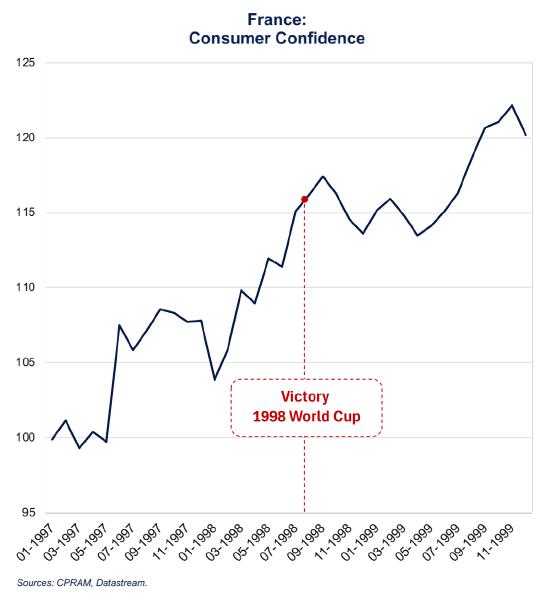
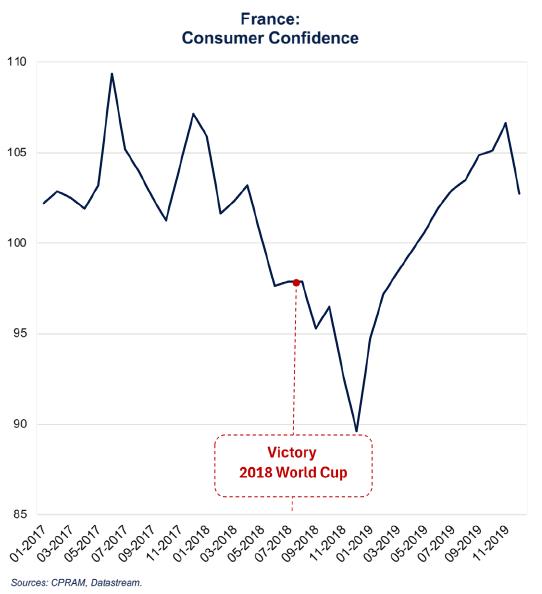
It should be noted, however, that a very hypothetical victory for the United States (ranked 16th in the FIFA rankings in May) could perhaps raise confidence indices and trigger a temporary "feel good" effect of limited magnitude, which could stimulate household consumption. However, France's victories in the 1998 and 2018 World Cups did not cause a very significant increase in confidence indices at the time.
The economic benefits of major sporting events
The economic benefits of hosting major sporting events are usually considered to be of several kinds:
- Private benefits directly related to participation in the event (ticket sales, broadcasting rights, sponsorship revenue, sale of derivative products related to the event).
- Private benefits indirectly linked to participation in the event (revenues related to transport, hotels, sales of drinks and food, ancillary tourism revenues).
- Private benefits related to the preparation of the event (employment in the construction sector and associated industries).
- The private benefits perceived after the event (use value of the new facilities built for the event).
- Public benefits (stimulus to the economy generated by investment and increased tourism-related consumption, higher productivity caused by improved infrastructure, improved image of the country leading to more trade and investment).
World Cup 2026: the economic match
Some economic remarks about the countries participating in the 2026 World Cup:
- Most of the G20 countries, i.e. the world's largest economies, have their teams qualified for the 2026 World Cup. The 5 exceptions are: three major Asian countries with no strong football culture (China, India, Indonesia), one country banned from major sports competitions (Russia) and one country... unfortunate for the third time in a row (Italy). China and India are also the two most populous countries in the world and Russia is the country with the largest area. They are major absentees.
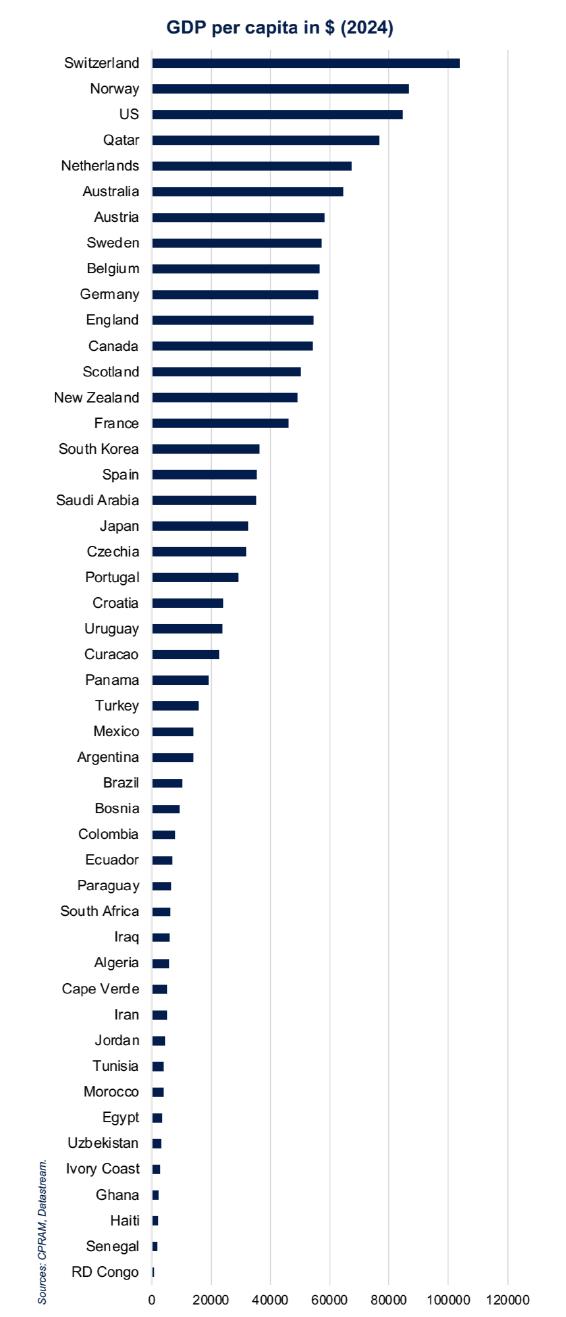
- Several of the richest countries in the world (when we consider GDP per capita) are qualified: Switzerland, Norway, the United States, Qatar. In particular, Group B contains two of the richest countries in the world (Switzerland and Qatar).
- Three countries on the United Nations list of "least developed countries" are participating in the World Cup: Haiti, the Democratic Republic of Congo and Senegal. While they are not on this list, GDP per capita is also very low in Ghana, Ivory Coast and Uzbekistan.
- Curaçao will become the smallest in terms of population to participate in a World Cup with 156,000 inhabitants (before that, the smallest participating country was Iceland). For the Curaçao – Germany match, the population ratio between the two countries will be 535. If Curaçao were to make it past the group stage and meet the United States, the population ratio would be 2180.
- World Cup participants include several countries associated with important global trade chokepoint:
o Panama: Panama Canal
o Iran: Strait of Hormuz (which is much in the news at the moment...)
o South Africa: Cape of Good Hope
o South Korea: Korean Strait
o Spain and Morocco: Strait of Gibraltar
o Turkey: Bosphorus Strait
o Egypt: Suez Canal.
- 4 of the 5 largest oil producers participate in the World Cup: the United States, Saudi Arabia, Canada and Iraq. The only absentee among the 5 is Russia.
- Among the participating countries are several of the oldest countries in the world. With a median age of more than 45 years in 2024, we find: Japan (49.9 years), Germany (46.8 years), Spain (46.8 years), Portugal (46.4 years), South Korea (45.5 years). On the other hand, there are two of the youngest countries in the world, with the DRC (16.9 years) and Senegal (19.2 years). The DRC - Portugal match will therefore pit one of the oldest countries in the world against one of the youngest countries.
- Among the participants are also several of the countries in the world with the highest inflation: Argentina (+219.9% in 2024), Turkey (+58.5%), Iran (+32.5%), Eqypte (+28.3%), Haiti (+26.9%). On the other hand, Iraq is the country in the world that experienced the lowest inflation in 2024 (-12.3%).
1 FIFA World Cup 2026: socioeconomic impact analysis.
2 We could also mention a large number of other professional sports leagues: WNBA, NFL, MLS, NWSL, MLB, PWHL, etc.
Find out more