Why this surge in rates this summer?
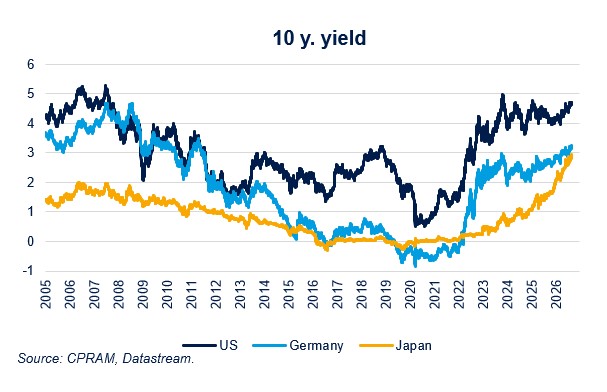
Since the end of June, 10-year yields in developed countries have increased by about thirty basis points. In particular, the 10-year German yield has reached its highest level in 15 years.
Published on 9 September 2026

This movement cannot be explained by a single factor but by a combination of factors, of which the four main ones are as follows:
1. The oil shock related to the conflict in Iran
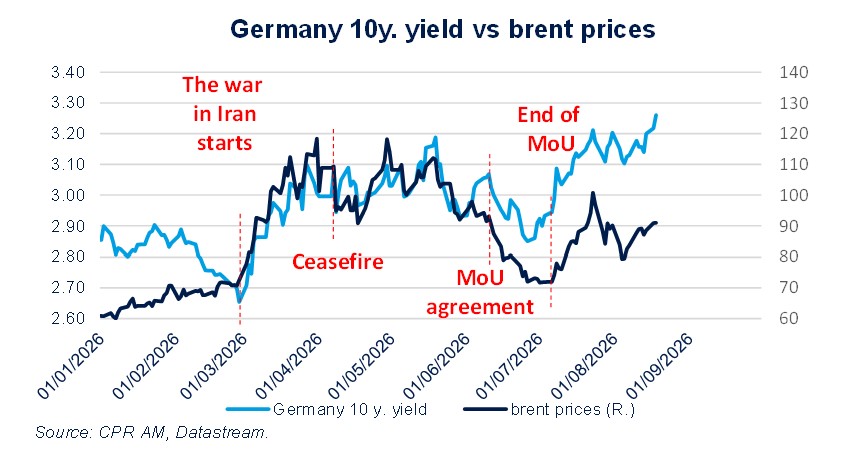
While a Memorandum of Understanding (MoU) had been signed by Iran and the United States on June 17 and had caused a drop in oil prices, negotiations stalled and Donald Trump indicated on July 8 that this agreement was over. The price of Brent crude oil thus quickly rose from around $70 to $100 before falling back to about $90 by mid-August. In the process, aggregated commodity price indices returned close to their highest historical levels. This revived fears of inflationary pressures and led markets to anticipate a slight tightening of monetary policy in developed countries. This is the main factor behind the rise in long-term interest rates this summer.
2. The "reverse crowding out" related to AI debt
The newest factor is the acceleration this year of bond issuances by hyperscalers to finance their data centers. Since the beginning of the year, the technology sector has been responsible for just over half of the increase in corporate bond debt with maturities longer than 10 years. This supply flow contributes to saturating the market's absorption capacity for long maturities: investors now demand a higher premium to subscribe, which pushes yields up across the entire curve, including for sovereign debt. This is the opposite of the classic crowding-out mechanism where government issuances displace the private sector: here, it is the massive borrowing by tech companies that drives rates up for everyone.
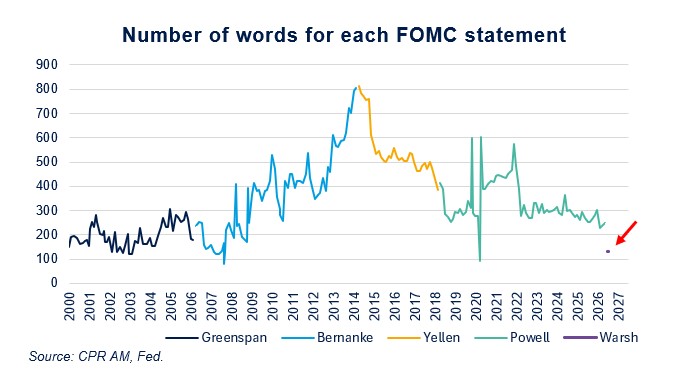
3. The radical change in communication from the Fed by Kevin Warsh
Confirmed as Fed chairman in May 2026, Kevin Warsh was initially supposed to embody the promise of lower rates desired by Trump. But once in office, the radical change in communication that he wanted to implement probably contributed to the rise in rates. His first two press conferences showed that he preferred to let the markets discover the likely path of rates themselves, based on economic developments, and preferred to stick to communication that does not close off options and maintains a degree of uncertainty. The abandonment of forward guidance and the desired reduction in public statements (which is expected to increase with a possible disappearance of press conferences) mechanically increase uncertainty about Fed policy.
4. The continuation of quantitative tightening (QT) by the ECB and the BoJ
In the eurozone, the ECB continues its full-scale QT policy by putting approximately €500 billion worth of securities back on the markets each year, which adds to about €500 billion per year of net government bond issuance in the eurozone. In Japan, the BoJ is also pursuing a QT policy. This simultaneous reduction of the ECB's and BoJ's balance sheets amplifies upward pressure on global yields: it also indirectly affects US rates because rising rates in the eurozone and Japan make US Treasury securities less attractive.
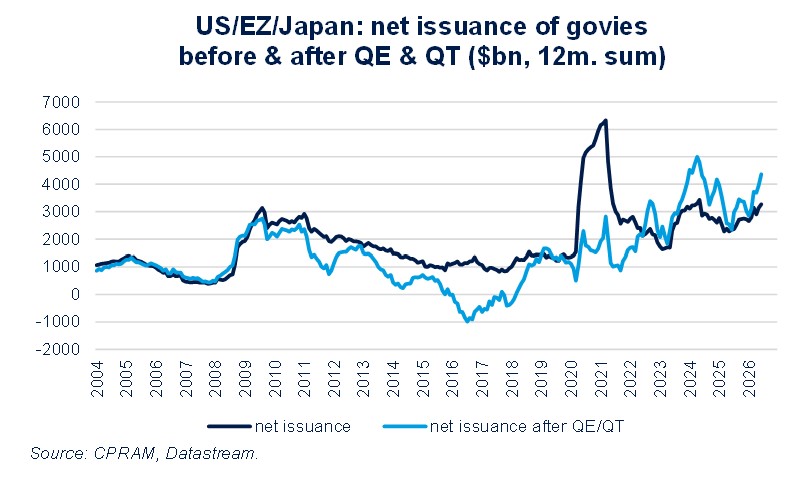
In summary, at least four factors explain the rise in long-term rates this summer: oil prices, the reverse crowding-out effect from tech issuances, a radical change in Fed communication under Kevin Warsh, and the full-scale continuation of QT by the ECB and the BoJ. It is this combination, rather than a single factor, that explains the movement.
Find out more