2026 US midterm elections: what are the implications?
As expected by polls and prediction markets, Democrats have regained control of both the House of Representatives and the Senate, but the scale of the Democratic wave is far greater than anticipated.
Published on 4 November 2026

A much stronger than expected Democratic wave
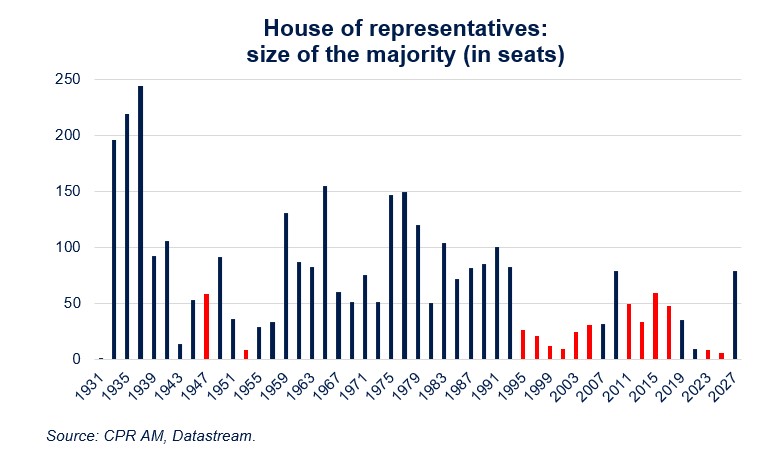
In the House of Representatives, Democrats are expected to win 255 to 260 seats, compared with 175 to 180 seats for Republicans. This would mark one of the largest majorities of the past 35 years.
In the Senate, Democrats are expected to hold 55 seats, versus 45 for Republicans (compared with 47 for Democrats and 53 for Republicans previously).
This is only the fifth time that one party has flipped both chambers in a midterm election. Among the most notable victories:
James Talarico’s victory in the Texas Senate race: he becomes the first Democratic senator from Texas since 1993.
Gina Hinojosa’s victory in the Texas gubernatorial election: she becomes the first Democratic governor of the state since 1995.
Adam Hamilton’s victory in the Kansas Senate race: he becomes the first Democratic senator from the state in nearly a century (since 1939).
Fiscal policy: two years of gridlock ahead
With a Democratic Congress and a Republican White House, no major new fiscal legislation should be passed before January 2029, meaning no significant tax increases or cuts, and no major changes in budget revenues.
While Congress holds the power of the purse, it would not be able to override a presidential veto, which requires a two-thirds majority in each chamber.
Fiscal policy is therefore likely to remain on autopilot: no fiscal stimulus, but no fiscal consolidation either.
However, two risks are emerging with regard to the debt and the budget:
- Shutdown risk: funding for the federal government, which was extended by a continuing resolution (CR) signed on September 2, expires on December 11, 2026. This issue will be dealt with by the outgoing Congress, which is still Republican. After that, however, each 2027– 2028 appropriations bill will be negotiated from a position of strength by Democrats.
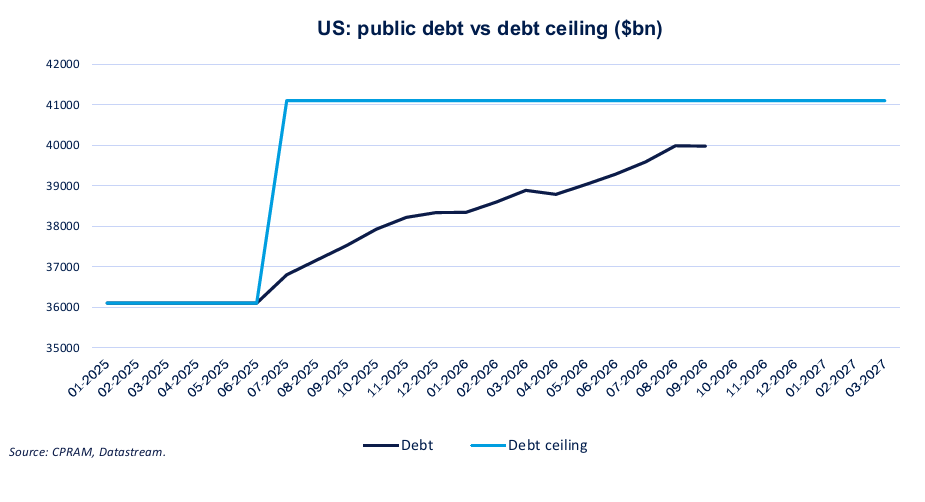
- Debt ceiling: set at $41.1 trillion by the Big Beautiful Bill, the ceiling is expected to be reached between February and July 2027, with the X-date that is (the date on which the Treasury is expected to run out of cash) estimated to fall between summer 2027 and February 2028. This would mark the first debt-ceiling standoff between a Democratic Congress and a Republican president, the reverse of the configurations seen in 2011 and 2023. The T-bill curve around the X-date will therefore be worth watching closely.
AI and data center cycle: risk is shifting to the local level
Public support for data centers was one of the campaign issues, and many candidates put forward proposals on the subject. This matters greatly, as a significant share of US growth in recent quarters has been driven by massive hyperscaler investment in data centers. Congressional hearings and investigative committees on the issue can therefore reasonably be expected.
Several points are worth highlighting:
- Texas: Gina Hinojosa, who has just won the gubernatorial election, has pledged to impose a moratorium on new data centers until the Texas legislature votes on new rules during its January 2027 session. Texas accounts for around 25% of planned capacity additions, and roughly one quarter of these projects would be exposed to this scenario.
- Georgia: Democrats have won control of the Public Service Commission, the state regulator overseeing gas, electricity and telecommunications markets, which recently approved a 10 GW grid expansion for data centers. They have indicated that they want data centers to bear the cost of their connection to the power grid, across a project pipeline of nearly 20 GW.
- Ohio: at least 14 municipalities have voted in favor of bans or restrictions on data center construction, including several Amazon projects.
It is also worth noting that 9 of the 10 states with the largest number of data centers have a Democratic governor — with Florida the only exception. That said, a number of states had already adopted regulatory measures. For example, Florida passed a law in July prohibiting the electricity infrastructure costs generated by data centers from being passed on to residents through their utility bills.
That said, even if adopted, the proposed measures would not call into question the vast majority of planned data center projects. Rather, deployment is likely to become slower, more selective and more costly, with location decisions shifting toward less hostile states and a greater share of energy costs being borne by hyperscalers.
Fed: a frozen Board of Governors
From January 3, 2027, any nomination to the Fed will have to be approved by a Democratic Senate. For reference, Kevin Warsh was confirmed as Fed Chair in May 2026 by 54 votes to 45, on an almost entirely partisan basis; under the new Senate composition, he would probably not have been confirmed.
As far as the Fed is concerned, the two positions relevant for the final two years of the Trump presidency are Philip Jefferson’s term as Vice Chair, which expires in September 2027 (although his term as Governor runs until 2036), and Jerome Powell’s term as Governor, which runs until January 2028. Powell’s departure (as well as any other early resignation) would create a vacancy that would be difficult for Donald Trump to fill. Likewise, the White House’s ongoing efforts to remove Lisa Cook would become pointless, as Trump would have no opportunity to replace her. As a result, Fed independence would emerge strengthened.
Find out more