An American-style Dutch disease?
The very strong performance of the technology sector contributes through various channels to pushing up long-term U.S. interest rates, which can hurt other sectors. This is reminiscent of the phenomenon known as "Dutch disease".
Published on 15 October 2026

Dutch disease: when one sector prospers at the expense of others
“Dutch disease” refers to the economic phenomenon in which the growth of one sector weakens the rest of the economy. The term was first used by The Economist in 1977 to describe the decline of the Dutch industry after the discovery of the Groningen gas field in 1959. In the years following that discovery, Dutch gas production rose sharply and the Dutch guilder appreciated almost continuously throughout the 1960s and 1970s. The Dutch disease phenomenon illustrates how the rise of one sector can come at the expense of the rest of the economy.
The phenomenon was later theorized in a model proposed by economists Max Corden and Peter Neary, published in The Economic Journal in 1982. This model distinguishes two channels. The first is the “spending effect”: the revenues of the booming sector boost aggregate demand in the country, which pushes up the price of non-tradable goods and, as a result, the real effective exchange rate, thereby penalizing other domestic exporters. The second is the resource movement effect: capital and labor leave traditional sectors, drawn by the higher wages offered by the booming sector. By siphoning off an increasing share of scarce resources, the most dynamic sector drives up costs for everyone and therefore penalizes the other sectors.
The Dutch disease phenomenon illustrates the fact that the rise of one sector can occur at the expense of the other sectors of the economy.
How the AI investment cycle is pushing up long-term rates
U.S. long-term rates have recently reached their highest levels in nearly 25 years, and the investment cycle in Artificial Intelligence (AI) has contributed to their rise through several channels that reinforce one another.
Within this cycle, U.S. hyperscalers¹ alone have invested around $400bn in 2025, are expected to invest more than $700bn in 2026 and more than $1,000bn in 2027. The macroeconomic scale of these amounts becomes clear when we consider that 1% of U.S. GDP currently equals $325bn. Even if roughly half of these investments go into semiconductors, they also cover power generation, transmission and storage, connectivity, cooling systems, and the construction of data centers.
These investments themselves generate a multiplier effect across other sectors and therefore contribute significantly to the strength of the U.S. economy seen this year.
This has been one of the year’s surprises and one of the reasons why the Fed raised rates in September, while markets had instead been expecting rate cuts at the start of the year.
Then there is a financial channel. For a long time, hyperscalers financed their investments with cash flow, but this is no longer the case. Hyperscalers have sharply increased their bond issuance this year, especially in longer maturities .
In the USD market, the size of these bond issues on 10-year and longer maturities, relative to equivalent U.S. Treasury issuance, is now significant.
Even if investors in sovereign bonds and in hyperscaler bonds are not necessarily the same, these issues have contributed to the rise in long-term rates, as both Kevin Warsh and Christine Lagarde have pointed out. In the battle for capital, one can also take into account the large equity issuances that have taken place in recent months and will continue in the months ahead.
There is also an inflationary channel. The very strong increase in demand for electronic chips has interrupted a decades-long trend of falling prices. The price of “memory” chips has risen more than eightfold in one year, and this is pushing up the prices of many electronic products such as smartphones, computers and medical equipment. In addition, the rollout of AI is running into physical constraints such as electricity supply, power grids and the availability of skilled labor. These price increases are helping keep inflation significantly above 2% (even if the main reason for higher inflation this year is the rise in fuel prices), which has contributed to the Fed’s more hawkish tone recently.
The rise in U.S. long-term rates is clearly not due only to the AI investment cycle, since higher fuel prices and the large federal deficit (around the 10th largest since World War II) are also playing a major role. But AI does play an important part, developing independently from other macro-financial trends.
An American-style Dutch disease?
With developments over recent quarters, the United States is increasingly exposed to a new form of Dutch disease, in which this time the channel would be higher interest rates. The core of the risk lies in an asymmetry: the technology sector, boosted by the massive investments mentioned above, is temporarily less sensitive to interest rates, while the rest of the economy is affected just as much as before.
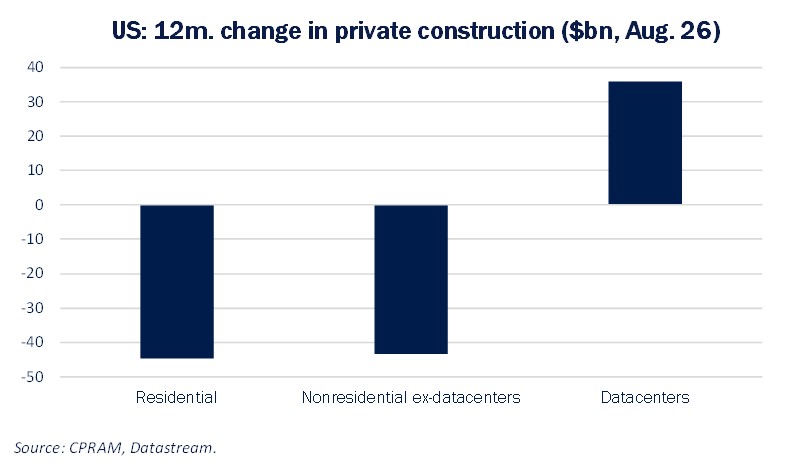
The first sector that comes to mind is clearly construction. In fact, 30-year mortgage rates have recently moved back above 7%, and the number of home sales remains close to its lowest levels since the subprime crisis. Over the past few months, residential construction spending has contracted sharply, as have non-residential construction expenditures excluding data centers. By contrast, data center construction spending has grown strongly. While residential investment has made a negative contribution to growth in seven of the last nine quarters, things do not seem likely to improve anytime soon.
In addition, other major purchases made by households, often financed through credit, such as cars or large household appliances, may be hurt by higher long-term rates. This may be offset by the fact that U.S. households have not been this lightly indebted since the late 1990s and by the strong increase in financial wealth over recent years. Even so, lower-income households should still feel the impact of higher rates. From an equity perspective, one can think of the consumer discretionary sector
.
More broadly, the sectors that are most indebted and benefit the least from AI-related investment are the most affected by higher long-term rates. This includes a number of SMEs and small companies, whose bank financing conditions are likely to deteriorate and most of which do not benefit from the AI cycle. The Russell 2000 index, which tracks smaller companies, has been under pressure since the end of August.
In principle, higher rates should benefit banks, as they can lend at higher rates. But the recent sharp rise in U.S. long-term rates has weighed on them in the stock market, notably because they hold a lot of Treasury securities. In addition, higher rates squeeze regional banks’ margins, as the cost of deposits rises faster than the yield on their loans, while their commercial real estate portfolios, already weakened by vacancy, are suffering from tighter refinancing conditions.
All these factors have contributed to a sharp divergence in equity markets since the end of August, with strong performance from technology stocks and declines in non-tech stocks.
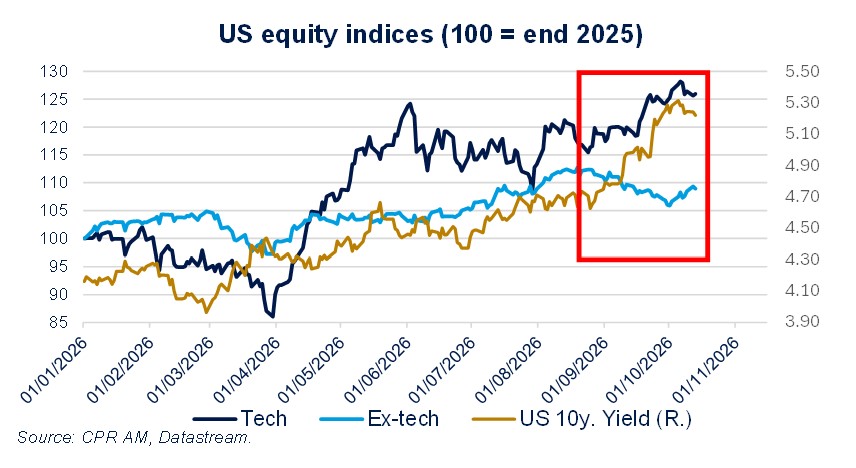
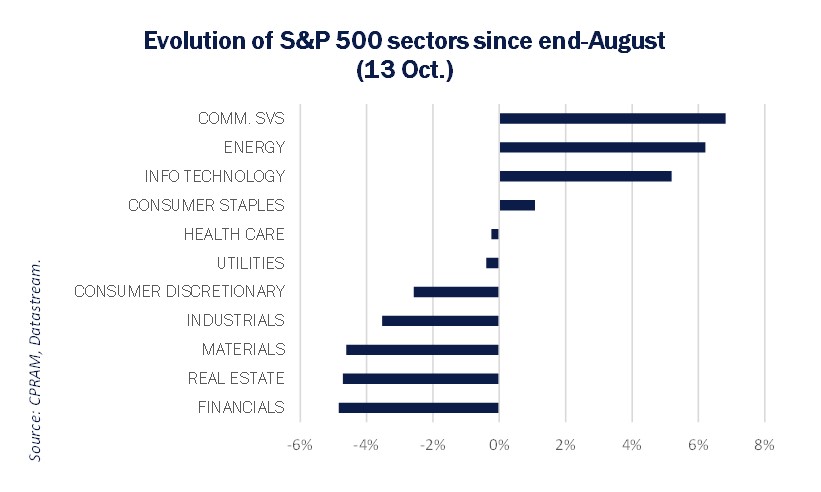
The AI investment cycle has contributed, through various channels, to the sharp rise in U.S. long-term rates since the end of August, and we have since seen a phenomenon reminiscent of “Dutch disease,” in which the strength of one sector ends up hurting the rest of the economy. In any case, the recent rise in long-term rates has weighed on the stock market, particularly for sectors that do not benefit meaningfully from the AI investment cycle. This is likely to remain an important lens for the months ahead.
1 - Here, we will consider Alphabet, Amazon, Meta, Microsoft, and Oracle
Find out more