Credit market: how to invest in a high-interest-rate environment?
The credit market environment has changed in recent months and could, in our view, now offer an attractive entry point for bond investors.
Published on 15 September 2026

Why are long-term interest rates rising in the United States and Europe?
In both the United States and Europe, yields have reached new highs, in some cases returning to levels not seen for several decades.
This rise reflects less a simple tactical reassessment by central banks than a deeper adjustment in investor expectations: inflation proving more persistent than anticipated, rising public financing needs and abundant bond supply.
The long end of the curve is bearing most of the pressure, suggesting, in our view, that markets are questioning governments’ fiscal trajectories as much as the path of policy rates.
10-year and 30-year yields: why does the long end of the curve remain under pressure?
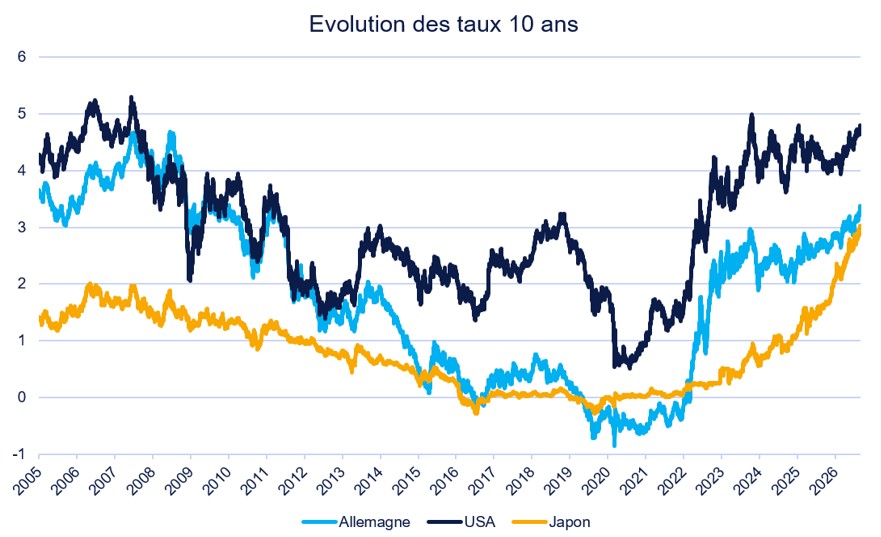
Current tensions are concentrated mainly on the long end of the curve. In the United States, Europe and Japan, 10- and 30-year yields have risen sharply, reflecting both concerns about future inflation, sovereign funding needs and a rebuilding term premium.
Markets are no longer pricing in monetary policy alone; they are also taking into account fiscal trajectories, debt supply and the ability of central banks to regain control.
In the United States, the size of the deficit, the growth in federal debt and the rising interest burden are maintaining structural pressure on long-term yields.
In Europe, the oil shock and geopolitical tensions are reviving inflation concerns and pushing the ECB to remain vigilant, or even to adopt an even more hawkish tone.
The conclusion is clear: yields are likely to remain elevated, and investors must contend with an environment that is more demanding, but also more rewarding.
How are credit markets withstanding rising interest rates?
In this environment, credit markets are holding up relatively well. The primary market is gradually reopening, as is generally the case after the summer period, and spreads remain broadly contained, particularly in Investment Grade.
The High Yield segment remains expensive in spread terms, but without any clear sign of stress. Investor appetite for quality remains intact, but is being expressed with greater discernment. Higher-rated issuers continue to enjoy market access, while names more sensitive to refinancing costs remain more exposed.
That said, there is currently no sign of widespread stress: the environment is certainly more challenging, but it is not a phase of capitulation.
For bond investors focused on all-in yield, this may mean that the risk/reward profile is becoming attractive again, provided they remain selective and disciplined.
Why should rates remain high?
In this context, our view is fairly clear: we are seeking to capitalize on this high-rate environment. The war in Iran has triggered a sharp reassessment of monetary policy expectations, particularly in Europe, where the energy shock is fuelling renewed inflationary pressure.
The ECB already tightened policy in June, and another rate hike in September is widely expected by the market. The message is clear: in the euro area, imported inflation remains the key watchpoint, keeping rates at elevated levels for longer.
In the United States, the picture is somewhat different. The market is pricing in a less restrictive Fed, but the long end of the curve remains under pressure, driven by deficits and substantial financing needs. In our view, this may create an attractive carry backdrop at longer maturities, while also requiring close attention to volatility.
Which strategies should be prioritized in a high-interest-rate environment?
In this configuration, we maintain a constructive stance on rates, with an overweight of 30 to 50 basis points depending on the portfolio, in order to benefit from elevated carry.
At the same time, the credit allocation continues to be managed prudently. We maintain a slight overweight in Investment Grade, while keeping a selective approach to High Yield. Spreads still look tight, but are holding up well, and the primary market is gradually reopening. In this context, issuer quality remains, in our view, decisive. Higher-rated issuers can offer an attractive balance between yield and resilience, while weaker credits require greater caution.
In this environment of historically high rates, we believe the credit market is offering opportunities. Buy & Watch strategies are becoming attractive again, with the aim of locking in compelling yield levels over a given investment horizon. Absolute return fixed income strategies are also appealing, as they seek to provide flexibility while avoiding uniform exposure to risk. Lastly, we also favour strategies focused on the short end of the High Yield curve, which still offers attractive carry despite tight spreads.
In short, as long as yields remain at these levels and the situation does not tip into a genuine crisis of confidence, bonds could retain strong appeal. It is precisely in this type of environment that investment expertise makes the difference, in our view: capturing carry, controlling risk and positioning portfolios in the most rewarding market segments.
Find out more