Europe’s Strategic Autonomy: From Theme to Structural Transformation
The European Strategic Autonomy journey started more than 3 years ago at CPRAM with the launch of the first European equity fund tackling this theme. The overall strategy accounts now more than 1.7 bn of euros1 and we are happy to share that our European Equity strategy has reached start of mid-June more than 1bn of euros of AuMs.
Published on 22 July 2026

A key reference on this topic is the Draghi Report: what are its main conclusions, and which sectors are most critical for European strategic autonomy?
The Draghi Report highlights a decline in Europe’s competitiveness, driven by slowing productivity growth, fragmented innovation, persistently high energy costs, and insufficient investment in R&D compared with the United States and China. It estimates that Europe faces an annual investment gap of around €800 billion, or roughly 4.5% of EU GDP, if it is to remain competitive.
The report also points to a 20% productivity gap with the United States, which has widened since 2000, largely due to underinvestment in technology, digitalization, and the energy transition. It further notes that no European company ranks among the world’s top 10 technology firms, describing this as an existential challenge that requires a strong industrial policy response.
To address these challenges, the report calls for a major shift in EU economic policy, including:
- significantly higher annual investment,
- reaching 3% of EU GDP in R&D spending,
- deeper integration of capital and energy markets,
- reduced regulatory complexity,
- faster innovation and technology adoption, especially in AI and advanced manufacturing,
- stronger industrial and defense policies,
- and more coordinated action among EU member states.
Its central message is clear: Europe must act collectively, decisively, and without delay to boost productivity, reduce external dependencies, achieve greater energy independence, close the innovation gap, and secure long-term economic growth. Otherwise, it risks continued economic decline relative to other global powers.
Is Europe slowing down or accelerating its efforts toward strategic autonomy, or is the theme already behind us?
Europe is accelerating—not abandoning—its push for strategic autonomy, with the past few months marking one of the most significant policy shifts in years. In the technology space, the EU has launched a major Technology Sovereignty Package, including Chips Act 2.0, a Cloud & AI Development Act, and an open-source strategy, all aimed at reducing dependence on U.S. and Asian technologies. The EU is also introducing a sovereign cloud framework for public procurement to further support digital independence.
On energy, recent disruptions and renewed concerns following tensions around the Strait of Hormuz have reinforced the urgency of reducing Europe’s exposure to external supply shocks. This has added momentum to EU efforts to strengthen energy resilience, diversify supply sources, and, over the long term, reshape Europe’s energy mix by investing in domestic production capacity so as to rely less on imports and move toward greater energy independence by increasing investment in renewables and nuclear.
In industry, the EU is likewise stepping up its response through initiatives such as the Industrial Decarbonization Act and Resource EU, which aim to support the transformation of Europe’s industrial base, secure access to critical resources, and reduce strategic dependencies. These measures reflect a broader effort to combine competitiveness, decarbonization, and sovereignty.
On defense, European leaders have reaffirmed their commitment to strengthening indigenous military capabilities, increasing joint procurement, and expanding European command structures. French President Emmanuel Macron has recently argued that Europe must be able to act more independently within NATO. At the same time, European defense companies are reporting a clear “buy European” trend, as governments increasingly favor domestic suppliers.
While implementation remains uneven across member states, the direction of travel is clear: Europe is moving faster toward greater defense, industrial, technological, and energy sovereignty than at any point in the past decade.
What is your view on the defense sector following the recent moves since the beginning of the year?
The European defense sector has underperformed so far in 2026, following two positive years in 2024 and 2025. This weakness is mainly due to profit-taking after a period of crowded positioning, increased caution around the sustainability of public defense budgets, and the sector’s high sensitivity to geopolitical headlines. Investors are also becoming more demanding on execution in a higher-valuation environment, while questioning how well companies are positioned for the changing nature of warfare.
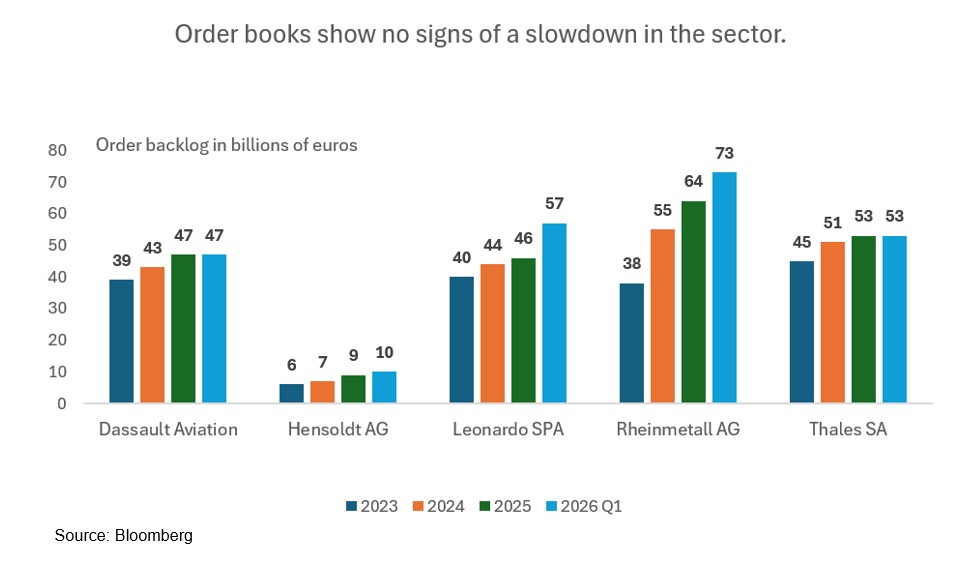
That said, we believe the investment case remains intact. European rearmament is still a long-term structural theme, supported by rising defense budgets and sovereignty concerns. Fundamentals remain solid, with strong order books and healthy commercial momentum at key names such as Rheinmetall, Leonardo, Thales, and Dassault Aviation. Following the recent correction, valuations have also become more reasonable.
Overall, the market is now taking a more selective view on defense, differentiating between companies based on execution quality, industrial exposure, and strategic positioning.
In both scenarios — whether tensions completely ease through a complete reopening of the Strait of Hormuz or remain elevated or re-escalate — Europe is steadily implementing a new industrial strategy designed to reduce dependency as quickly as possible and, ultimately, resolve it over the long term.
The conflict in the Middle East presents new security challenges. There is broad consensus that by 2035, Europe must be prepared to face a high-intensity conventional war and numerous European countries aim to be prepared for 2030's defense spending target. Donald Trump’s return to the White House is also encouraging Europeans to act quickly and in a coordinated way, as they recognize the need to be able to guarantee their own security. It is therefore essential that European industry invest in new capabilities and be ready, within ten years, to operate under a wartime business model. This represents a genuine paradigm shift.
European countries have already materially increased defense spending in volume terms: Germany +44%, France +15%, Italy +37%, Spain +58%, and the Netherlands +75%.
Are small- and mid-cap companies key to the theme?
European small- and mid-cap companies are becoming a key way to invest in the strategic autonomy theme, as the next phase of European reindustrialization is expected to benefit not only large defense champions but also the many specialized suppliers providing critical technologies in defense, cybersecurity, semiconductors, aerospace, robotics, and advanced manufacturing. While large caps have already seen significant re-rating, SMIDs may offer greater long-term growth potential as defense budgets and industrial investment accelerate across Europe. In this context, defense-sector IPOs are also becoming increasingly attractive, as governments and investors seek to finance the expansion of Europe’s industrial base, although careful stock selection remains essential with newly listed companies.
1. Source : CPRAM, data as of 30/06/2026
Find out more