Adaptation, a long-neglected aspect of climate change
The IPCC1 defines adaptation to climate change as “the process of adjusting to current or future climate conditions, as well as their consequences.” While climate shocks are already occurring and are unevenly distributed across the planet, climate change adaptation policies are being developed around the world. They still fall far short of existing needs, especially since these needs will continue to grow as the impacts of global warming intensify. In this short article, we revisit the challenges of adapting to climate change.
Published on 2 June 2026
Adaptation, Now an Indispensable complement to mitigation
Global warming has already increased the frequency and intensity of extreme weather events: heatwaves, fires, floods, droughts, and so on. Indeed, climate- related extreme events cost an average of $215 billion per year globally between 2005 and 2024, according to EM-DAT2, and this figure could rise to between $1.7 trillion and $3.1 trillion per year by 2050, depending on the warming scenarios that unfold, according to Report on the Economic Cost of Climate Change by the Institute and Faculty of Actuaries’ and the University of Exeter’s (2024).
While policies to mitigate global warming must remain a priority, adaptation is also essential to help populations and states reduce their vulnerability, i.e. to prepare for and reduce the negative effects of climate change.
Adaptation encompasses activities aimed at preparing for and preventing climate-related physical risks, responding to physical risks, and rebuilding after damage by improving resilience. It is thus different from loss and damage management because it aims to build resilience rather than covering losses after damage has occurred. To be effective, it must not be merely a reaction to a shock, but an anticipatory approach designed over the long term.
The Global Center on Adaptation (GCA) identifies three priority areas for action: food security, infrastructure and water management, which includes both water supply and flood and drought management.
Adaptation is both collective and individual and can take many forms beyond direct government funding of infrastructure, as the private sector must also adapt to this new reality.
COPs and Adaptation Goals
While the issue of adaptation to climate change emerged in the early 2000s, it was COP21 (2015) that recognized adaptation as a fundamental issue in the fight against climate change by dedicating Article 7 of the Paris Agreement to it. It launched the “Global Goal on Adaptation” to “build capacity for adaptation, strengthen resilience to climate change, and reduce vulnerability to climate change, with a view to contributing to sustainable development and ensuring an adequate adaptation response.”
COP26 (2021) launched a work program to achieve this goal, which let to the definition of thematic targets for climate change adaptation and resilience in 2023. Seven thematic targets have been identified: agriculture, health, water, infrastructure, ecosystems, poverty and livelihoods, and cultural heritage.
At the COP in Belém in 2025, a list of 59 indicators was associated with these thematic targets.
However, this list of indicators is far from set in stone because measuring and setting adaptation targets poses many methodological challenges: the relevance of the chosen indicators, comparisons between countries, lack of reliable underlying data, difficulty in measuring progress, difficulty in integrating qualitative elements, etc.
A significant funding gap
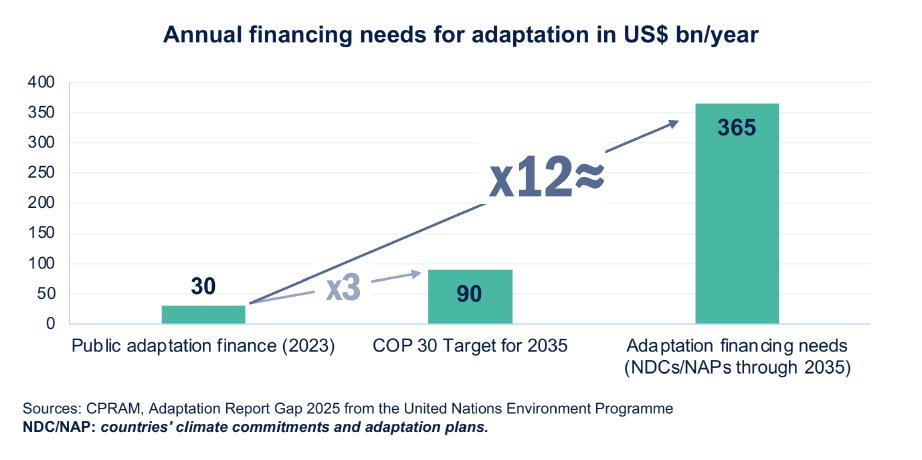
Adaptation represents only 10% of climate finance, which has mainly focused on mitigation policies. It is therefore facing a significant funding gap that continues to grow.
This gap is estimated at between $284 billion and $339 billion per year until 2035, according to the United Nations Environment Programme’s Adaptation Gap Report 2025, compared with financial flows that currently amount to $30 billion. For the private sector, which is also involved in the implementation of adaptation strategies, investment should increase from the current $5 billion per year to $50 billion per year to help reduce the gap.
At COP30, the goal of tripling funding for climate change adaptation by 2035 was adopted, but this will not be enough to close the gap entirely, as it would have needed to be increased twelvefold. The issue of financing is a major concern for the most vulnerable countries, which are already facing the adverse effects of climate change and want more immediate aid.
Implementing Adaptation
Adaptation is conceived at the local level since it is contextual, but the COPs provide a common framework for understanding the issue and common criteria for measuring progress in this area. They also allow for the sharing of experiences, cooperation between countries, and a more comprehensive understanding of the issue based on local realities, which are often only partially captured.
Planning is essential in this area, and Governments play a strategic coordination role among the various stakeholders. The solutions deployed are all the more effective if they are cross-sectoral and planned for the long term. The public sector thus bears three-quarters of the investment efforts for adaptation.
In total, 172 out of 197 countries worldwide have a national adaptation plan, strategy, or policy. The European Union adopted its first adaptation strategy in 2013 and updated it in 2021.
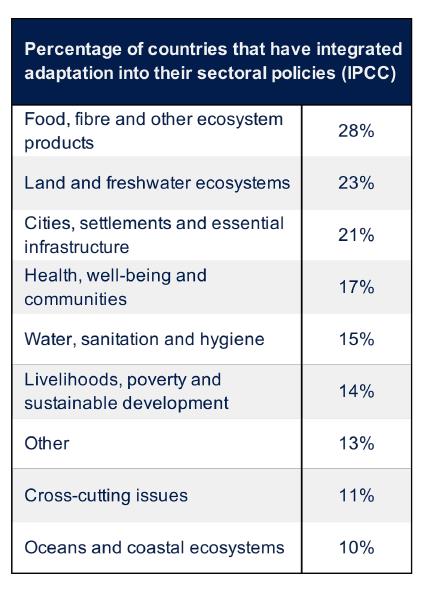
Source: CPRAM – IPCC (Climate Change 2022: Impacts, Adaptation and Vulnerability, Working Group II Contribution to the Sixth Assessment Report)
Two levers can be implemented to build resilience: protecting existing assets and implementing solutions that allow other players to adapt. Technological advances are helping to bring out new solutions. Adaptation therefore includes a very wide range of activities: climate information systems, early warning systems, flood prevention and irrigation, regenerative agriculture, cooling technologies, network resilience, micro-grids, energy efficiency and water management systems, construction, insurance, health, etc. Climate specialists warn of the risk of "maladaptation", which would consist of taking actions that increase vulnerability to climate change instead of reducing it. They cite as examples the use of air conditioning without investment in insulation or calibration errors, such as the construction of a dike that would not be high enough and would not allow it to fully fulfil its role in the event of major flooding.
A relative consensus on the need for adaptation
According to the EIB’s3 climate survey, 50% of respondents believe that adapting to climate change is a priority for their country, and this share rises to 65% in southern Europe, which is warming faster.
In the United States, a study published in the Journal of Environmental Psychology shows overall support for adaptation to climate change, with Republicans expressing greater support for adaptation than mitigation, in contrast to what is noted for Democrats.
Adaptation to climate change is increasingly emerging as a necessity with rising temperatures and the frequency of climatic events, and as an essential complement to mitigation policies. Progress in understanding the issues at stake has been significant in recent years and the subject has become the subject of a relative consensus, but the question of associated funding remains largely unresolved. Indeed, investments in the field represent only 10% of the needs identified and must therefore accelerate to meet the challenges.
1- Intergovernmental Panel on Climate Change
2- Report 2025 Disasters in numbers: Earth, Wind, and Fire
3- European Investment Bank, Annual climate survey, November 2024.