Climate: Summer 2026, a summer marked by climate disasters
Summer 2026 was marked by several climate disasters in Europe. We look back at the records set this summer and the impact of these climate events on the European economy.
Published on 9 October 2026

The hottest August on record worldwide and in Europe
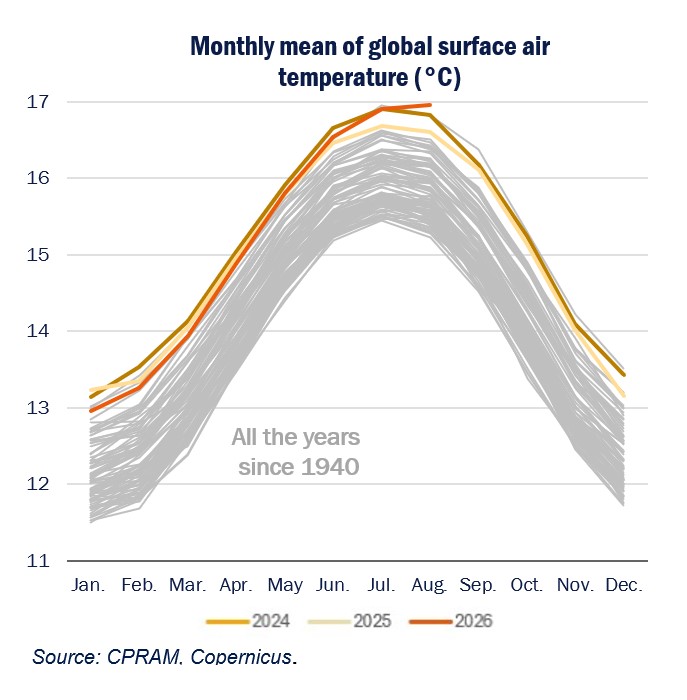
The European observatory Copernicus indicated that August 2026 was the hottest on record worldwide, at +1.65°C above pre-industrial levels (1850–1900). Copernicus also indicates that summer 2026 was the hottest ever recorded in Western Europe (+2.54°C compared with the 1991–2020 period), well above summer 2003. Climate warming is nearly twice as fast in Europe as in the rest of the world, making adaptation even more urgent.
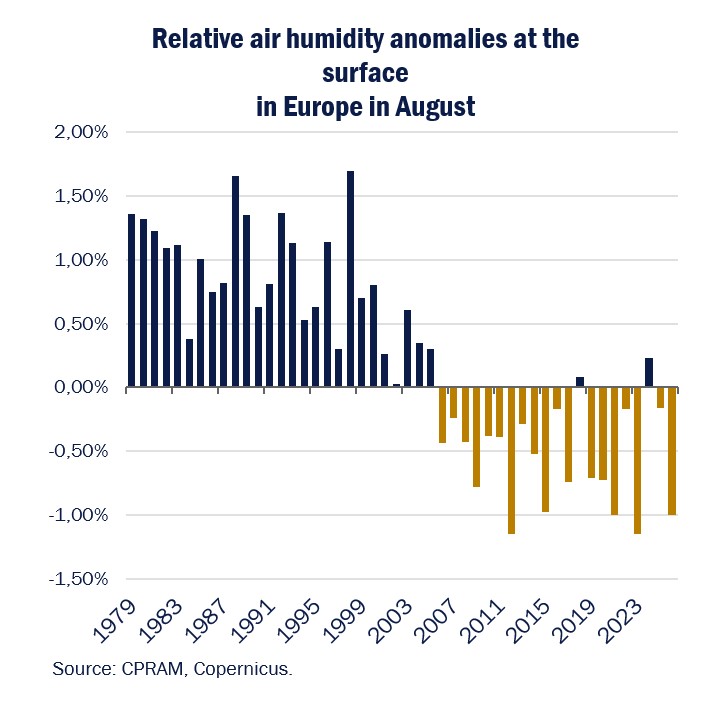
Drought in Europe during August has become the norm
In Europe, low rainfall from April 2026 onwards combined with extreme temperatures in spring and in summer, led to a sharp decline in water reserves and river flows in summer. This for example affected hydroelectric production. Surface drought levels were high in August 2026 according to Copernicus data. If it is not a record year (2022 was worse from this point of view), the most striking element of the series of anomalies which goes back to summer 1979, is the now almost systematic nature of August drought conditions in the month of August since 2006. It therefore seems that it is a lasting trend that now appears to be taking hold.
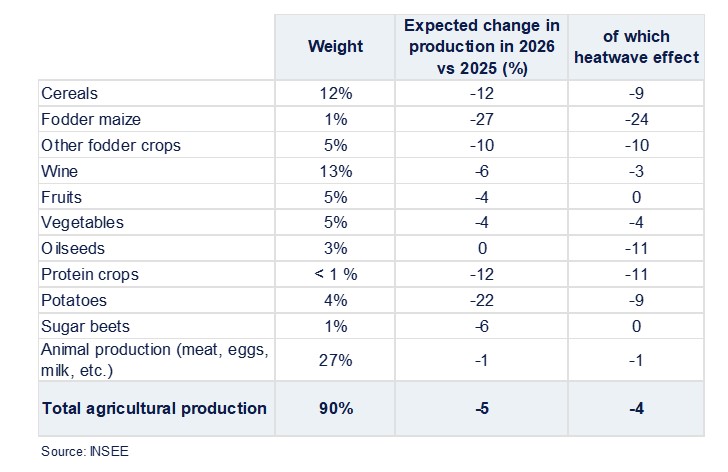
The combination of very high temperatures and temperatures not falling below 20°C at night, together with a lack of precipitation, has obvious consequences for agricultural yields in Europe. According to the forecasts of the Joint Research Centre (JRC) of the European Commission, which ensures monthly monitoring of the state of crops in the European Union, the yields of several major summer crops should be clearly below their average of the last five years: soybeans (-15%), fresh maize (-14%), sugar beet (-11%), grain maize (-8%) and potatoes (-7%). It also indicates a strong decrease in winter fodder production. The state of yields of vegetable crops is also critical.
According to the JRC, summer 2026 provides a glimpse of the growing challenges European agriculture now faces related to climate warming. It highlights the need to improve the resilience of the agricultural sector through better anticipation of agricultural risks and better water management.
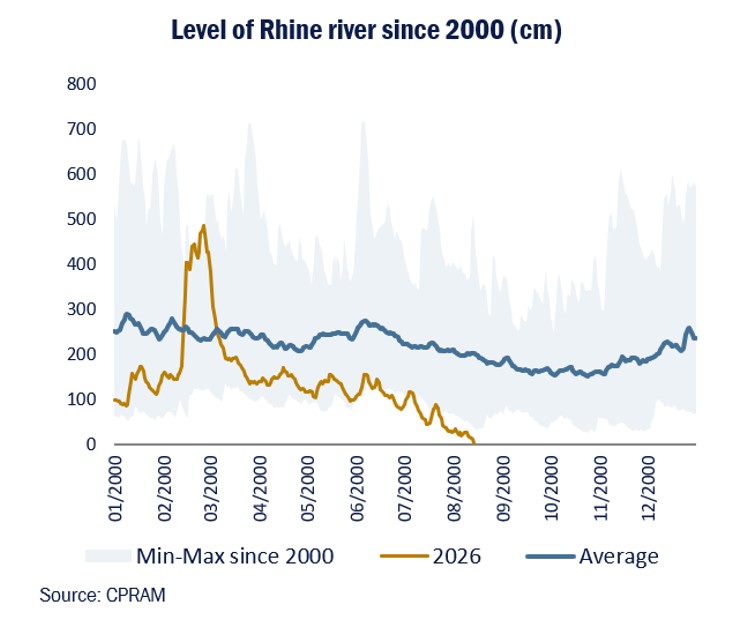
Beyond the agricultural world, the low rainfall had a significant impact on river levels across Europe, as shown by the level of the Rhine below, which reached its lowest level on record in August 2026. This has major economic repercussions by limiting river traffic and the cooling capacity of thermal power plants. The chemical and steel sectors in Germany are very dependent on their river supplies and feared supply disruptions. The Danube also made the headlines because its low level led to the shutdown of nuclear reactors in Hungary, Romania and Bulgaria and limited the use of irrigation in Serbia.
Record-breaking wildfires
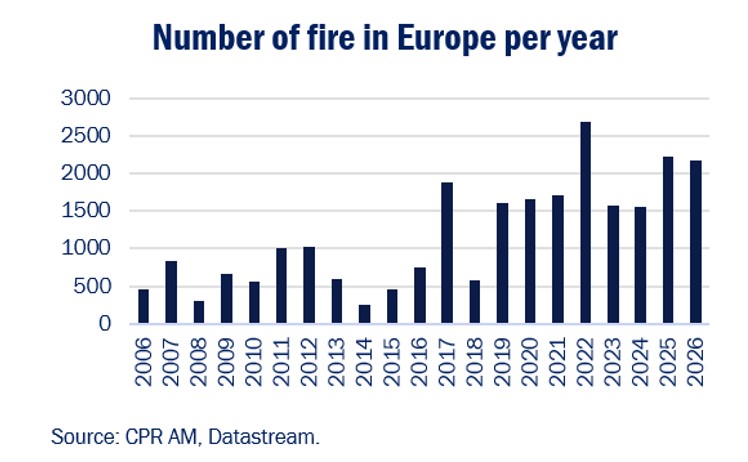
According to Copernicus data, Europe experienced more than 2,000 fires in 2026. Although this is not a record year in terms of the number of fires, we can see, as with drought, a significant increase in the number of fires per year since 2016.
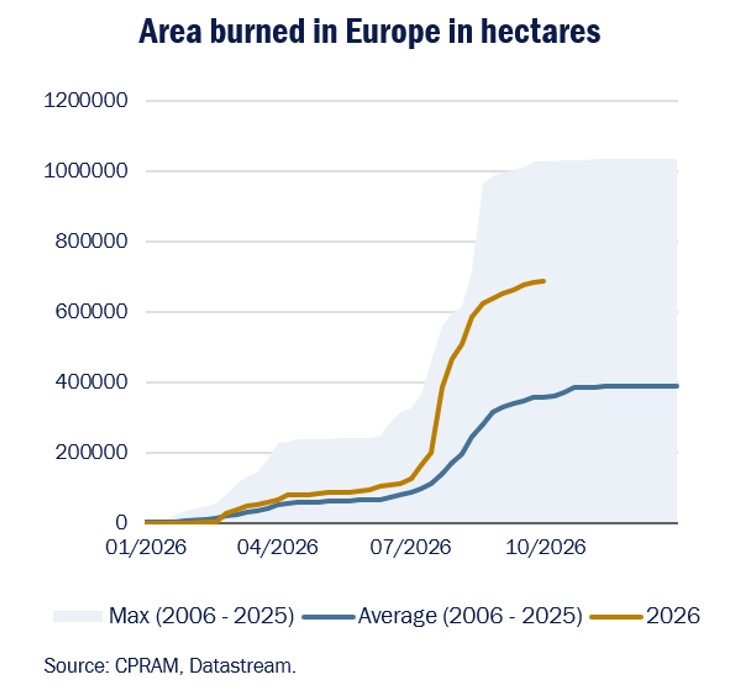
Burned area, at nearly 700,000 hectares at the end of September, are smaller than in 2025 or 2017, but they were still twice the average area burned by that point between 2006 and 2025.
Country data show that for France, Italy, Spain, Belgium and Estonia, the affected areas have exceeded previous records by a wide margin.
These climate events have a high economic cost but are difficult to assess
The range of estimates of the economic cost of this summer’s climate events is very wide depending on the scope taken into account: reconstruction costs, agricultural losses, lower productivity, the value of destroyed assets, environmental costs.
For France, the minister for the climate transition estimated the direct and indirect cost of this summer’s heatwaves, droughts and fires at between €10 billion and €15 billion. In its September 2026 economic note, INSEE estimates that the summer heatwaves would cost the French economy 0.1 percentage point of annual growth in 2026, or nearly €3 billion, essentially because of the decline in agricultural production. France Assureurs estimates the cost of insured damage linked to this summer’s fires at €500 million. It is difficult to measure the cost of destroyed natural capital: losses for biodiversity, disruption of ecosystems, cost of reforestation, etc.
According to Allianz’s report on the climate economy, published at the end of September 2026, climate change has an economic cost linked to asset destruction, but it also affects productivity, inflation, consumption, public finances and therefore growth. In Europe, the 2026 heatwaves generated production losses estimated at €113 billion, or 0.46% of its estimated GDP. Italy would be the country most affected relative to the size of its economy.
Summer 2026 simultaneously highlighted most of the challenges that climate change will confront us with in the coming years: drought, fires, lower agricultural production, reduced nuclear power output, supply constraints, etc. It therefore highlights the need to continue the climate transition but also to build resilience at the continental level in order to limit the negative impacts of global warming on our lives and our economies.