The yen’s big moment? Towards a shift in the exchange rate against dollar
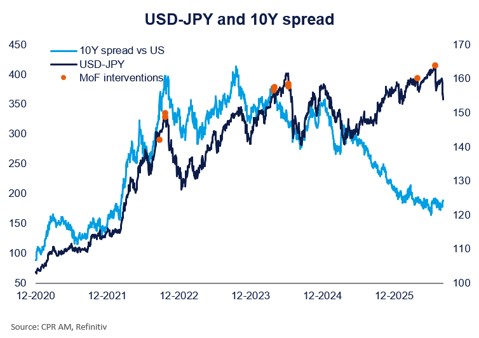
The summer of 2026 could well mark a genuine regime shift for the yen. After hitting 40-year lows against the dollar, the Japanese currency rapidly appreciated, returning to levels that prevailed prior to the conflict in the Middle East.
Published on 10 September 2026

Why is the yen appreciating against the dollar in 2026?
This shift appears all the more unexpected given that it follows a series of failed unilateral interventions. The Ministry of Finance had indeed deployed record sums—with foreign exchange reserves shrinking by approximately $175 billion since April—including through joint actions with the US Treasury (a first since 1998), yet without having a lasting impact on the yen’s trajectory.
The genuine turning point seems to stem more from a change in the authorities' *modus operandi*, combining three complementary approaches:
- a more restrictive Bank of Japan;
- increased pressure on Japanese investors;
- continued close collaboration with the US Treasury.
How does the Bank of Japan's tightening support the yen?
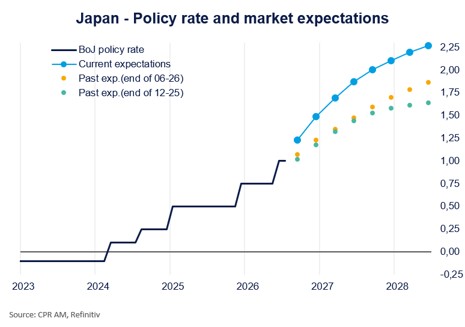
Previously staunchly opposed to monetary tightening, the Takaichi administration now appears more inclined to give the central bank a free hand.
This shift is largely driven by the recent re-acceleration of prices (with the trimmed mean inflation rate returning to 2% in July), and the BoJ is expected to seize this window of opportunity to tighten monetary policy.
Several members, including Governor K. Ueda, called for accelerating normalization in August—triggering a significant shift in expectations. Another rate hike at the September meeting appears certain, and investors now anticipate a terminal rate exceeding 2%.
Why does the Japanese government encourage investors to prioritize domestic assets?
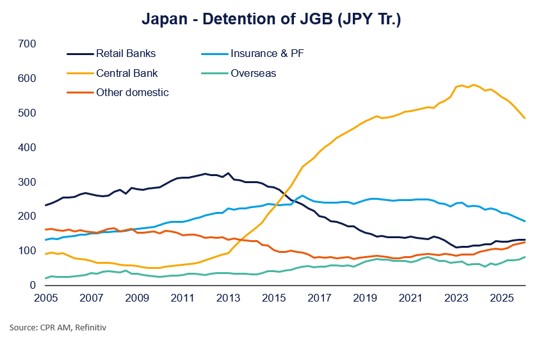
Another key factor is the shift in the focus of government pressure: previously concentrated on the central bank, it is now increasingly directed at Japanese investors.
These investors are being urged to increase the share of domestic assets in their portfolios. This approach serves a dual purpose:
- facilitating the financing of an expansionary fiscal policy, particularly against the backdrop of reduced bond purchases by the Bank of Japan;
- supporting the Japanese currency by encouraging capital repatriation.
Could a reallocation by the GPIF strengthen the yen?
A potential reallocation by the Government Pension Investment Fund (GPIF) could have significant repercussions. As Japan’s largest pension fund, the GPIF manages approximately $2 trillion in assets.
While still hypothetical at this stage, an increase in its exposure to Japanese assets could bolster domestic demand and contribute to the appreciation of the yen.
What role do the Japanese Ministry of Finance and the US Treasury play?
Finally, a hardening of the authorities' stance has been observed very recently. Despite the yen’s renewed appreciation, several spokespersons for the Japanese Ministry of Finance indicated in early September that they remained ready to intervene and still had the backing of the US Treasury’s firepower.
This message has also been echoed and reinforced on several occasions by Scott Bessent, who sent very explicit signals to investors through punchy statements ("I am the house now […] and you can bet against me if you want").
The yen remains the US authorities' primary tool in their quest to drive down the dollar more broadly.
Does the yen's rebound signal a lasting change in trend?
In summary, the current period appears to be a pivotal one for the Japanese currency, which remains a key cog in international financial markets.
The yen’s recent — and abrupt — reversal reflects the convergence of several factors, but these still need to be confirmed, and another false start cannot be ruled out given how high expectations have now become.
Conversely, the room for further appreciation remains substantial, and any acceleration in the move would raise the risk of a large-scale unwinding of carry trade strategies.
Such a scenario would have repercussions far beyond Japan, much like the volatility shock of August 2024.
One thing is certain: investors are likely to continue watching the Japanese currency extremely closely.