Fed: Christopher Waller, the shadow chairman
Six months after Kevin Warsh took over as Fed chair, it is already possible to make an initial assessment. Fundamentally, the picture is paradoxical: the man chosen by Donald Trump to cut policy rates oversaw the first rate hike since 2023 in September, and another increase now looks likely at the Dec. 9 FOMC meeting. But the sharpest break lies elsewhere – in how Warsh communicates, or rather, no longer communicates. And that silence has brought another voice to the forefront: Christopher Waller.
Published on 17 November 2026
Kevin Warsh had warned that he wanted to put an end to “forward guidance” and stop giving indications about future Fed policy. He kept his word, but his approach has largely consisted of speaking less and less. In six months, he has given only one speech on monetary policy, at the Jackson Hole central bankers’ conference. His press conferences are now about twice as short (roughly half an hour) as those of Ben Bernanke, Janet Yellen or Jerome Powell. In addition, he is the only FOMC member not to take part in the “dot plot” exercise, meaning he does not provide rate projections for the years ahead. In short, the Fed chair speaks little, and when he does speak, he says as little as possible.
But nature abhors a vacuum. Markets have not stopped trying to understand how the Fed reacts to data and, lacking that from its chair, they are seeking the answer elsewhere. And if Kevin Warsh communicates far less than his predecessors, the other members of the Fed Board continue to give speeches at the same pace. Among them, Christopher Waller has established himself as the markets’ preferred interlocutor. A Board member since 2020 and former research director at the St. Louis Fed, he was one of the finalists to succeed Jerome Powell. He therefore has both the intellectual credibility and the desire to influence the committee’s decisions.
Last week provided a striking demonstration of this. A few hours before October inflation was published, Christopher Waller said that if core inflation proved as strong as in the previous two months, a 50-basis-point rate hike might be needed in December. No one had mentioned that possibility before. With core inflation coming in as strong as in the previous two months, the repricing of monetary policy expectations was abrupt: Over the week of November 9–13, the U.S. 10-year yield saw its biggest weekly increase since the start of the year, rising by around 30 basis points. In one sentence, by giving a signal about what the Fed might do, Christopher Waller triggered a powerful market move ... even though it is essentially the opposite of the approach Warsh had wanted to impose . For the October FOMC meeting, Waller had also given a strong indication ahead of the committee in favor of holding rates steady, and markets followed him.
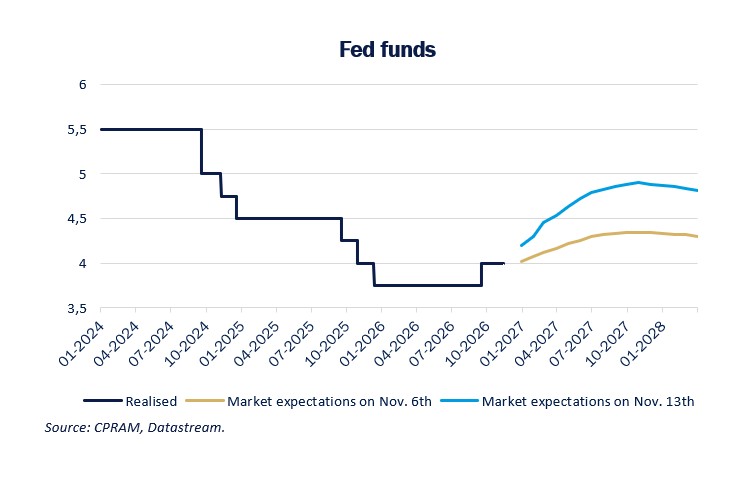
Even if Christopher Waller speaks only in his own name, and not on behalf of the committee, the market now grants him almost the authority of a Fed chair. This clouds the reading of the Fed’s reaction function and fuels rate volatility. Above all, it puts Kevin Warsh in an uncomfortable position, since his method has been rendered ineffective: he has not abolished forward guidance, he has simply outsourced it.
Find out more