Monetary Dominance 1 – Fiscal Dominance 0
The highly unusual backdrop of monetary tightening at a time when Western countries are carrying high levels of debt and running large deficits has set the stage for a contest between monetary dominance and fiscal dominance. For now, monetary dominance is prevailing, and real rates have risen in recent months.
Published on 24 September 2026

An unusual policy mix between fiscal and monetary policy
The major Western economies are indeed in an unusual configuration: fiscal policy remains clearly expansionary, with public deficits still at historically high levels outside crisis periods in most G7 countries, even though the economic cycle no longer really justifies it; at the same time, monetary policy is either restrictive or in a tightening phase, under the effect of the renewed inflation triggered by the war in Iran.
Take the United States: the federal deficit is expected to hover around 6% of GDP in 2026, making it roughly the 10th highest annual deficit since the Second World War, behind years such as 2009/2010/2011 (in the wake of the Great Financial Crisis) or 2020/2021 (the Covid crisis). At the same time, the Federal Reserve’s target range for policy rates (3.75%/4%) is significantly higher than the average policy rate over the past 40 years (3.3%).
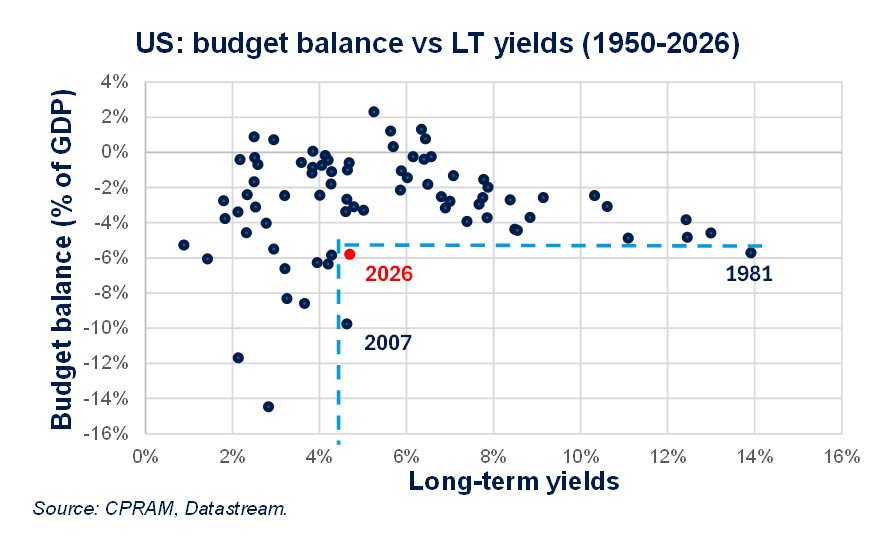
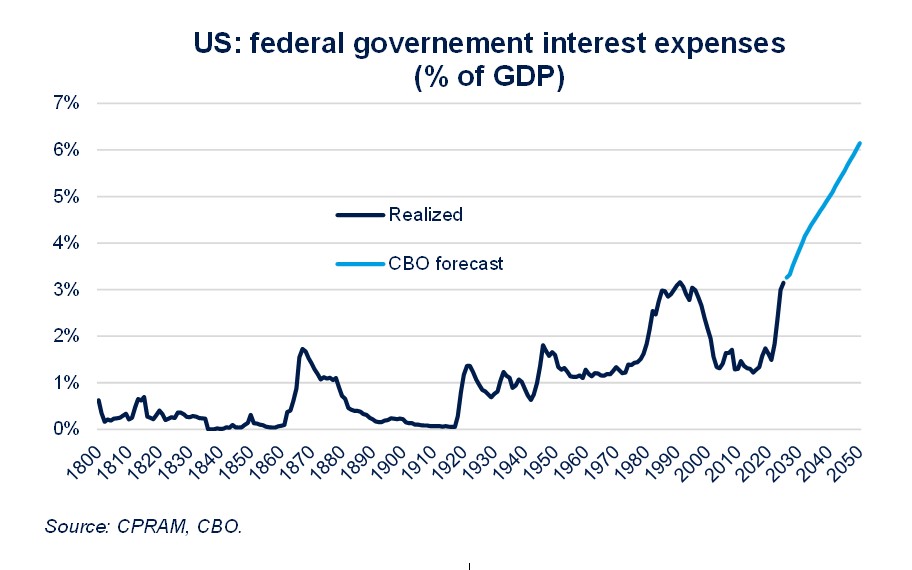
This combination of large public deficits and fairly high or high policy rates is highly unusual. Over recent decades, deficits have typically been high during recessionary phases, that is, at the same time as very accommodative monetary policy (very low policy rates), while deficits have generally been reduced over the course of the cycle in tandem with the normalisation of monetary policy. In the current setup, the natural question is which side of economic policy can, should and/or will dominate the other: fiscal policy or monetary policy?
The victory of monetary dominance despite the threats
In 1981, economists Thomas Sargent and Neil Wallace introduced the notions of “monetary dominance” and “fiscal dominance” in their paper Some Unpleasant Monetarist Arithmetic. We speak of “monetary dominance” when monetary authorities are entirely focused on controlling inflation, raising interest rates if necessary when inflation is too high, so that the government must then adjust its fiscal policy to remain on a sustainable debt path. Conversely, there is “fiscal dominance” when monetary policy is constrained by the need to keep the government solvent, meaning maintaining interest rates low enough for it to borrow cheaply, at the expense of its price stability mandate. This question is closely tied to that of central bank independence.
In truth, the intense pressure exerted by the Trump administration on the Fed (the attempt to dismiss Lisa Cook, the Department of Justice investigation into Jerome Powell, repeated insults, etc.) partly fits within this framework, because one of the reasons Donald Trump wants the Fed to cut policy rates is that it would make it easier to finance the US government. In that respect, it is paradoxical that it was Kevin Warsh — the person Donald Trump chose to lead the Fed in the hope of securing rate cuts — who ended up leading the institution in raising policy rates a month and a half before the midterm elections. Incidentally, what looks like a personal reversal on Kevin Warsh’s part may be explained less by a doctrinal conversion than by a more prosaic reality: the Fed is run by a group of people, not by its chair alone, and Warsh’s initial plan was probably not shared by the majority of the FOMC. This episode shows that the existing institutional framework still protects the Fed’s independence: a President of the United States may choose a new face, but cannot dictate monetary policy, simply because the FOMC remains a collegial body.
As for Europe, Isabel Schnabel, a member of the Executive Board of the European Central Bank (ECB), has repeatedly stressed that the euro was created on the basis of a model of “monetary dominance”. In her view, the forceful response of the ECB and other developed-market central banks during the 2021/2022 inflation episode served as a clear and powerful reminder of that principle.
How monetary dominance is fuelling the rise in long-term rates
The predominance of monetary dominance is contributing, alongside other factors (oil prices, bond issuance by hyperscalers, etc.), to the current pressure on long-term rates. The logic is straightforward: higher interest rates immediately raise the refinancing cost of public debt, which must be rolled over continuously; this higher cost then weighs on the fiscal balance (with interest expense having become, in several Western countries, one of the very largest spending items), which in turn increases financing needs and therefore the volume of bonds issued whenever no fiscal adjustment improves the trajectory of primary balances. As a result, the deterioration in the public debt trajectory leads investors to demand an additional risk premium, thereby pushing long-term rates higher. This feedback loop is all the stronger when the stock of public debt is large. Another factor accelerating the process is that most developed countries have increased the share of T-bills in their debt issuance, which speeds up the pass-through from higher policy rates to a heavier debt burden.
This mechanism broadly echoes the core intuition of the Sargent and Wallace (1981) argument mentioned above: when the fiscal authority does not adjust its primary balances sufficiently, monetary policy may sooner or later be forced to deviate from its mandate in order to alter the debt trajectory. In May this year, this is exactly what Isabel Schnabel explained in her speech The quiet erosion of central bank independence: “If fiscal policy behaves irresponsibly, monetary policy may eventually be forced to monetise government debt, resulting in fiscal dominance. [..] If doubts about fiscal trajectories were to intensify, term premia, which have already risen from the low-rate era, could increase further. This could impose constraints on monetary policy because excessively high policy rates could threaten fiscal sustainability.”
how this has affected rates in recent months
In recent months, long-term rates have risen in both the United States and the euro area בעיקרarily through real rates, which reflects the predominance of monetary dominance. Several developments have triggered an acceleration in real rates :
- The May employment report, which came in far stronger than expected, removed the need for the Fed to maintain a cautious stance with regard to its full-employment mandate;
- The Jackson Hole conference, where Kevin Warsh stated that the Fed needed to prioritise its price stability mandate over its full-employment mandate;
- The ECB rate hike (almost coinciding with a weaker-than-expected US inflation report) and the accompanying press conference, during which Christine Lagarde showed no concern about the rise in long-term rates. Implicitly, this amounted to a reaffirmation of the principle of monetary dominance.
By contrast, the July FOMC meeting, at which the Fed did not raise rates on the grounds that the rise in long-term rates itself amounted to a tightening of financial conditions, led to a temporary stabilisation in real rates.
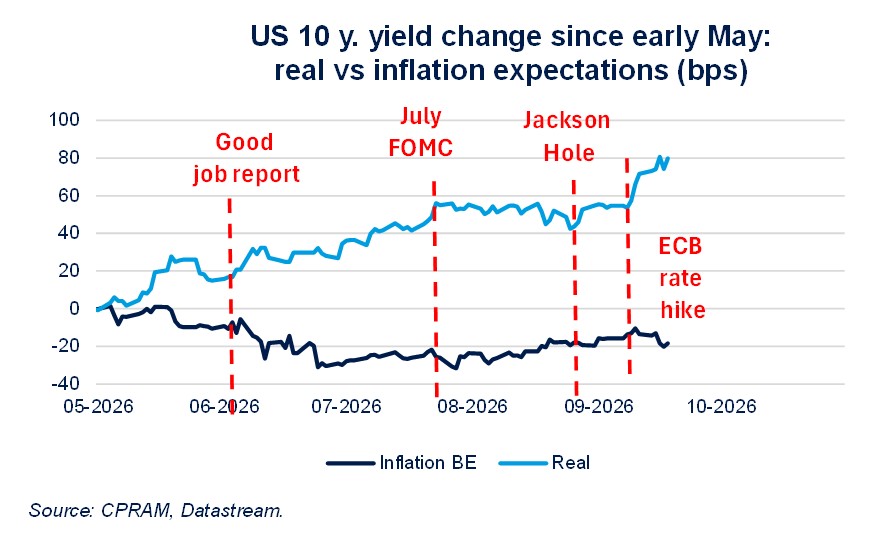
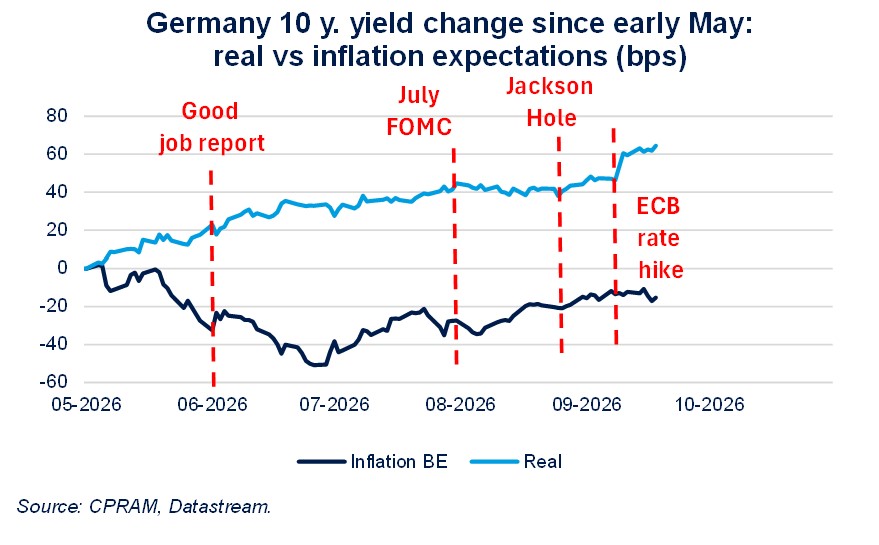
For now, monetary dominance is prevailing: central banks, led by the Fed and the ECB, have reaffirmed the primacy of their price stability mandate, even in a context of high public deficits. That said, this victory comes at a price, as it translates into higher real rates and, through debt servicing costs, adds to the pressure on long-term rates. Paradoxically, the rise in risk premia, with its consequences for growth and long-term financing conditions, could therefore, sooner or later, force central banks to adjust their stance if governments continue to postpone their own adjustment.
Find out more